

What You Need To Know
Here’s what happened around the city for the week of February 8, 2026:
- Union Ends Strike After Deal Reached with SFUSD: What the Contract Actually Says
- GrowSF Endorses Phil Kim for School Board
- New BART Gates Net $10M per Year, Reduce Station Maintenance Needs
- Planning Commissioner Kathrin Moore Hit With Ethics Fine
Union Ends Strike After Deal Reached with SFUSD: What the Contract Actually Says
Published February 13, 2026

The Facts
The Facts
SFUSD says it signed a tentative two-year agreement with United Educators of San Francisco (UESF) Teachers Union at 5:30 a.m. on Friday, Feb. 13, ending the four-day strike.
GrowSF reviewed the full tentative agreement PDF (13 pages). Here’s the deal, plus what the District initially offered, what UESF demanded, and what the neutral fact-finder recommended in the lead-up to the strike. The deal is roughly in-between the initial offer and the fact-finder’s recommendations, and significantly less than the union’s initial demands, reflecting the fiscal reality of the district.
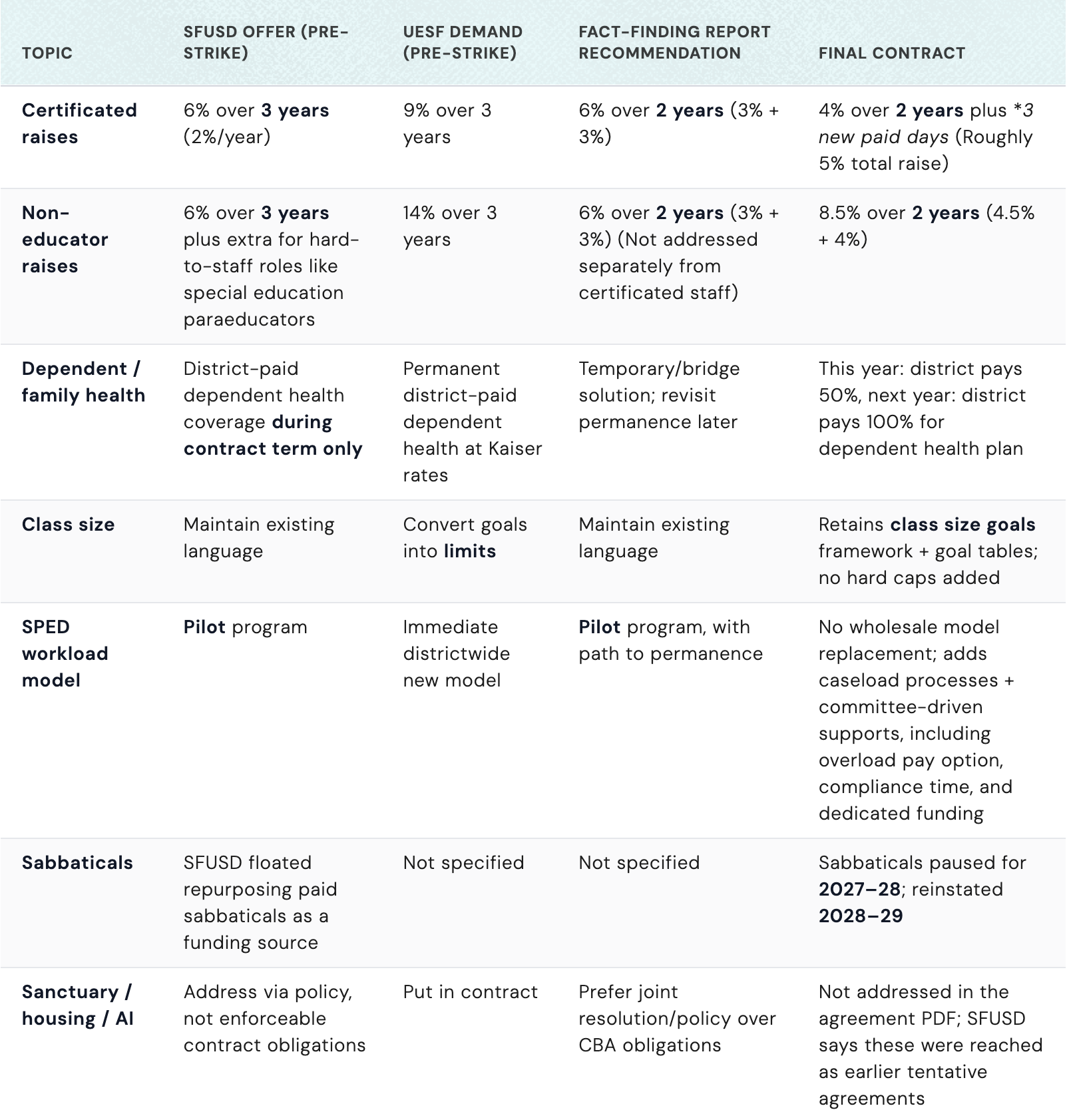
Side-by-side: offer vs demand vs recommendations vs final contract
Here’s a side-by-side comparison of the district’s initial offer, the union’s demands, the neutral fact-finder’s recommendations, and the final contract agreement for key disputed items:
More details on the contract agreement
TEACHER PAY: 4% over two years plus three added work days
What they agreed to:
2% raise effective July 1, 2025.
2% raise effective July 1, 2026.
Three added work days: two added to the end of 2025–26, and one added to the beginning of 2026–27.
This is roughly equivalent to a 5% raise over two years, but it comes with more working days. Since no reduction in prep periods, paid leave, or other duties was part of the deal, layoffs are now looking likely for the upcoming school year.
Note that the date for the first raise is in the past. That’s because teachers have been working without a contract since July 2025, so the raises are retroactive to the start of the school year.
What the union demanded:
9% to 14% over three years
What the district offered:
2% raise effective July 1, 2025
2% raise effective July 1, 2026
The district stated that these raises would be paid for based upon savings accomplished by eliminating AP Prep periods for teachers, paid sabbatical leaves, department head preps and stipends, and class size limits.
What the neutral fact-finder recommended:
6% over two years (3% + 3%)
DEPENDENT HEALTH CARE: 50% employer contribution first year, 100% employer contribution second year
What they agreed to:
Starting July 1, 2026, the district pays 50% of the employee contribution for the Kaiser HMO plan at the employee+1 and family coverage levels.
Starting Jan. 1, 2027, the district pays 100% of the total premium for Kaiser at employee-only, employee+1, and family coverage levels.
Members choosing a non-Kaiser plan pay only the difference between that plan and Kaiser.
Eligibility is defined as working 50% or more of a full-time assignment and already receiving an employee-only premium contribution.
What the union demanded:
Permanent 100% employer contribution for dependent health coverage (no cost to employees)
What the district offered:
District-paid dependent health coverage during the contract term only, paid as a $24,000 “benefits allowance”
What the neutral fact-finder recommended:
A temporary solution using existing parcel tax revenues (2008’s Proposition A parcel tax) to cover dependent health care costs, with a recommendation to revisit permanent coverage later
NON-EDUCATOR RAISES: 8.5% over two years
What they agreed to:
Fon non-educator staff:
4.5% raise effective July 1, 2025
4% effective July 1, 2026
The agreement also includes several other classified provisions that didn’t get much attention in early coverage, including:
A 5% differential for paraeducators providing specified specialized medical services.
A change to bi-monthly pay for classified staff effective July 1, 2026.
Security aides being offered an 8-hour workday effective July 1, 2026.
What the union demanded:
14% raises for non-educator staff
What the district offered:
2% + 2% raises
Augmenting salaries (i.e. paying more) for hard-to-staff special education paraeducators
What the neutral fact-finder recommended:
Same as educators: 3% + 3% raises
CLASS SIZE: no change
What they agreed to:
Retains the existing class size language, which emphasizes class size goals rather than enforceable limits (Class Size Article 9, including 9.5).
What the union demanded:
Convert class size goals into enforceable limits
What the district offered:
Retain existing class size language
What the neutral fact-finder recommended:
Retain existing class size language
SPECIAL EDUCATION WORKLOAD: no immediate overhaul, but new processes, supports, and funding
What they agreed to:
Early reporting often summarized changes to special education as “no major workload change” or “no immediate overhaul.” That’s directionally true—this isn’t a wholesale districtwide workload-model replacement. But the contract does add multiple specific workload and support mechanisms, including:
Caseload overages: within 15 workdays of exceeding the applicable goal, there must be a consultation; then, within 15 workdays after that consultation, one of the following remedies may be implemented: (a) overload pay of $1,000 per semester per student over the goal, only when the caseload is not more than two students over, or (b) additional staff, or (c) reassignment.
A stronger set of “equitable distribution of workload” expectations, including an escalation path to a Joint Special Education Committee if not resolved at the site and supervisor level.
Elementary compliance time: uninterrupted time during the student day of 60 minutes per week.
Secondary compliance period: encouragement to provide a compliance period, plus the district committing $2 million in 2026–27 (in collaboration with the Joint Special Education Committee) to fund compliance periods where they don’t exist.
A “complexity indicators” framework and a required response: when a unit member flags complexity indicators, the Joint Special Education Committee reviews within 15 days and can implement supports like assessment coverage, adjusted schedules, substitute release days, clerical help, temporary staffing, or centralized specialists.
A stated $2 million per school year budget for special education improvements.
What the union demanded:
Immediate districtwide implementation of a new workload model
What the district offered:
A pilot program to test a new workload model
What the neutral fact-finder recommended:
A pilot program to test a new workload model (the report does not clearly state an automatic districtwide rollout trigger)
The Context
Before the strike, SFUSD publicly described a proposed three-year “stability package” featuring district-paid family health benefits, a special-education workload pilot, added pay for hard-to-staff paraeducator roles, and a 6% raise spread over three years (2% per year). That was outlined in the district’s Jan. 31 negotiations update.
GrowSF’s Feb. 6 “School Strike Facts” Special Report compiled the key disputed items (and the neutral fact-finder’s recommendations). In that accounting, UESF was pushing for significantly larger raises (9% to 14% over three years) and permanent district-paid dependent health coverage at Kaiser rates, along with broader changes on special-education workload and other non-wage issues.
For completeness, the neutral chair’s full findings are in the public fact-finding report.
The GrowSF Take
This deal was always going to end this way. The union leadership knew the district didn’t have the money for their full set of demands, and the district knew it would have to balance any increases in one area with cuts in another. It’s ultimately entirely unsurprising that the final agreement is roughly in line with the district’s last public offer and the neutral fact-finder’s recommendations. The financial reality always led here.
So 50,000 kids lost a week of school, parents lost a week of work, and the city lost a week of economic activity, all for a deal that was always going to be in this ballpark. And we think that this deal is likely to result in teacher layoffs for the upcoming school year, because the raises weren’t accompanied by corresponding cuts elsewhere, and the strike cost the district at least $28 million, according to Superintendent Su’s estimates.
GrowSF Endorses Phil Kim for School Board

We recommend voting for Phil Kim for the Board of Education.
Phil has both the experience and the track record that SFUSD needs. Phil is a former public school student and teacher, and a lifelong educator. He led STEM education and policy at K-12 public schools across 20+ states and 300+ schools. He has a Masters in Education, and is currently pursuing his doctorate in Education. Since he joined the Board in 2024, Phil has used his deep understanding of how other school systems have improved student outcomes to begin the process of improving SFUSD’s. He was unanimously elected President by his fellow commissioners in January of this year.
We think Phil has done a great job working with the Board and our Superintendent over the last year and a half to get SFUSD back on track, and would like to see him continue his work. And we think he did a great job during the strike, ensuring parents were informed and the district agreed to something it could afford.
New BART Gates Net $10M per Year, Reduce Station Maintenance Needs
Published February 12, 2026

The Facts
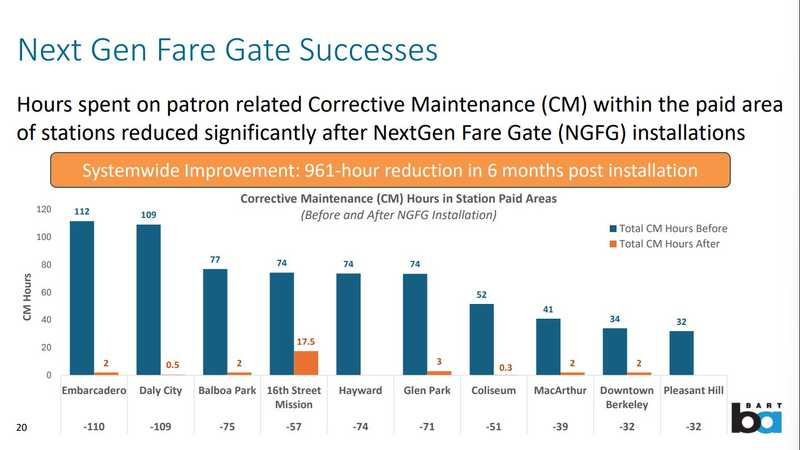
BART’s new “next generation” fare gates, now installed at all 50 stations, are generating an estimated $10 million per year and saving 961 hours of station “corrective maintenance,” according to reporting by Rachel Swan at the San Francisco Chronicle.
BART shared an astonishing graphic showing the huge decrease in station “corrective maintenance” hours, meaning time spent cleaning up graffiti, vandalism, broken things, etc, pre- and post-gate installation:
The Context
BART’s fare gate project is a roughly $90 million effort to harden stations against fare evasion and reduce the damage and disruption that comes with it. By generating an extra $10 million per year, and reducing maintenance costs all while increasing safety and overall cleanliness, this project will have paid for itself in just a few years.
The gates appear to be improving rider experience: BART reported that the share of riders who said they witnessed fare evasion fell from 22% to 10% over roughly a year as the gates rolled out, in a BART project update.
BART says it will hit a fiscal cliff when pandemic aid runs out in spring 2026, with $350M–$400M annual operating deficits starting FY2027, per BART’s financial crisis overview.
The GrowSF Take
It turns out that a small portion of riders cause almost all of the problems, and the same people who hop the gates also exhibit other anti-social behaviors that make stations less safe, less clean, and less pleasant for everyone. By investing in infrastructure to reduce fare evasion, BART is not only increasing revenue but also improving the overall experience for riders and reducing maintenance costs. We love to see it!
Planning Commissioner Kathrin Moore Hit With Ethics Fine
Published February 11, 2026

The Facts
Planning Commissioner Kathrin Moore was fined $12,000 for conflict-of-interest violations tied to votes on projects involving Skidmore, Owings & Merrill (SOM), which paid her about $15,000/year in retirement income, according to Gabe Greschler at The Standard.
An Ethics Commission agenda describes four counts for participating in governmental decisions while financially disqualified, involving projects at 1750 Van Ness, 98 Franklin, and 530 Sansome/447 Battery—nearly $900 million in total project costs.
The Context
San Francisco’s ethics rules require public officials to recuse themselves from decisions where they have a financial interest, to prevent conflicts of interest and maintain public trust. A financial interest includes receiving $500+ in income in the prior 12 months.
The Planning Commission votes on all development projects, and in the past has rejected some even if they are fully compliant with all local laws.
The GrowSF Take
We’re glad to see our ethics rules enforced, though a $12,000 fine on total payments of $400,000 (in the 27 years Moore has been receiving retirement income) is not exactly a strong deterrent.
A better approach would be to allow legally compliant projects to be approved by City staff, without discretionary votes by commissioners with outside interests. This would not only reduce corruption risk, but also speed up housing approvals.