

Voting has begun! Your mail-in ballot has either already arrived or will arrive in the coming days. It’s a long ballot this year: 11 local and regional measures, 14 state propositions, and all the standard races from Governor down to the Community College Board.
The full GrowSF Voter Guide covers every contest in depth. This is a highly abridged version.
How to vote. Mail your ballot back (no postage necessary!) by Tuesday, November 3, or drop it in any city ballot box or at your polling place by 8 p.m. on Election Day. You can also vote in person at City Hall on weekdays starting October 5 (except October 12), and on the weekends of October 24-25 and October 31-November 1.
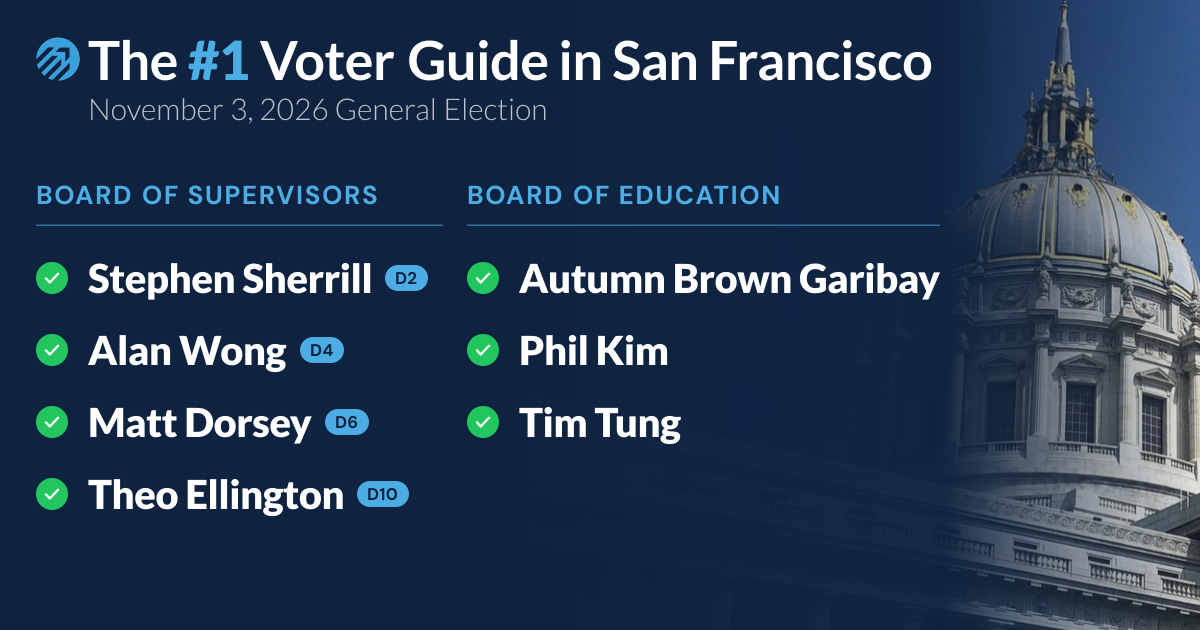
Our full slate, at a glance
San Francisco candidates
D2 Supervisor: Stephen Sherrill
D4 Supervisor: Alan Wong
D6 Supervisor: Matt Dorsey
D8 Supervisor: No endorsement (see write-up, below)
D10 Supervisor: Theo Ellington
Board of Education (vote for all three): Phil Kim, Tim Tung, Autumn Brown Garibay
Community College Board (vote for all three): Elijah Ball, Monroe Lace, Erwin Tam
Community College Board, Partial Term: Ruth Ferguson
BART Board, District 8: Sara Barz
Assessor-Recorder: Joaquín Torres
Public Defender: Mano Raju
San Francisco measures
Prop A (Fewer City commissions): Yes
Prop B (Public bank): No
Prop C (Housing fund): Yes
Prop D (Higher bar for ballot measures): Yes
Prop E (One rulebook for City purchasing): Yes
Prop F (Mayor runs City departments): Yes
Prop G (Reopen the Great Highway): No
Prop H (Muni parcel tax): Yes
Prop I (Transfer tax earmark): No
Prop J (Tax foreclosures): Yes
Prop RTM (Regional transit sales tax): Yes
State and federal candidates
Governor: Xavier Becerra
Lieutenant Governor: Fiona Ma
Secretary of State: Shirley Weber
Controller: Malia Cohen
Treasurer: Eleni Kounalakis
Attorney General: Rob Bonta
Insurance Commissioner: Ben Allen
Board of Equalization: John Pimentel
Superintendent of Public Instruction: Richard Barrera
State Assembly D17: Matt Haney
State Assembly D19: Catherine Stefani
House D11: Scott Wiener
House D15: Kevin Mullin
Judicial retention: Yes on all 13
State propositions
Yes: 1, 2, 3, 5, 37, 41, 42, 43, 45
No: 4, 38, 39, 40, 44
Board of Supervisors
You’ll see one of these races if you live in District 2, 4, 6, 8, or 10.
District 2: Stephen Sherrill. Before he was Supervisor, Sherrill ran the Mayor’s Office of Innovation. As Supervisor he voted for Mayor Lurie’s Family Zoning Plan, co-sponsored the Mayor’s RV homelessness legislation, and passed a plan to fill long-vacant storefronts on Van Ness, which has 53% ground-floor vacancy.
District 4: Alan Wong. Mayor Lurie appointed Wong in December 2025, and Sunset voters confirmed the choice in June with 64.3% in the final round. His first vote was for the Family Zoning Plan. He co-sponsored doubling the maximum fine for sideshows and accepting a $6.25M federal grant that funds 50 police officer positions.
District 6: Matt Dorsey. Dorsey is in recovery, and his first term turned recovery into City policy. His Recovery First ordinance made long-term remission the official goal of the City’s drug programs. This July he passed his Drug-Free Housing ordinance, because only 42 of roughly 8,500 supportive housing units were drug-free, even though about 26% of fatal overdoses happen inside supportive housing. He also championed the speed cameras that have cut speeding by 10+ mph about 80% at camera locations.
District 8: While we had endorsed Manny Yekutiel, we withdrew our endorsement after two more credible allegations of inappropriate behavior were reported. Manny has announced he has dropped out, but he’s still on the ballot. Our District 8 page compares where all candidates stand on police staffing, drug policy, housing, small business, and other issues voters tell us they care about. While we aren’t making a specific endorsement, we hope the information is still useful for voters when making up their minds.
District 10: Theo Ellington. About 20,000 approved homes sit stalled in D10 at Pier 70, the Power Station, India Basin, the Shipyard, and Candlestick, and Theo wants real timelines with penalties for developers who sit on approved land. He organized his neighbors into a class action against the Shipyard contractor that lied about soil safety, winning a $6.3M settlement, and he wants full retesting with independent oversight. He supports full police staffing and opposes supervised drug-use sites.
Schools and City College
Board of Education: Phil Kim, Tim Tung, and Autumn Brown Garibay. Vote for all three. Kim, the Board President, cast the deciding vote to bring algebra back to 8th grade, and on his watch the district climbed out of its “negative” budget rating without laying off teachers. Tung spent 20 years auditing budgets, 12 of them at S&P Global Ratings, and wants the district to build a real cash reserve. Brown Garibay, a public school parent of three and former PTA president, wants an enrollment system families can navigate and literacy and math goals that show up in every school’s plan and budget.
Community College Board: Elijah Ball, Monroe Lace, and Erwin Tam. Vote for all three. City College’s enrollment has fallen by a quarter in a decade. Tam, a former City College student, has spent 25 years as a financial advisor to more than 30 California community colleges. Lace teaches at a public school and wants to expand Bridge to Success, which walks SFUSD seniors through enrolling. Ball plans college campuses for a living and wants a use for the Downtown Campus that closed this year.
Community College Board, Partial Term: Ruth Ferguson. Ferguson is running unopposed. More than 90 cents of every flexible City College dollar goes to salaries and benefits, above the state’s 85-cent ceiling, and she backed the Chancellor’s reorganization to bring that down.
Other local offices
BART Board, District 8: Sara Barz. Barz co-founded Seamless Bay Area, worked on Clipper and its low-income fare discount, and then spent years at Apple putting transit cards into Apple Wallet.
Assessor-Recorder: Joaquín Torres. Torres is unopposed and has earned another term. He made San Francisco the first county in California to offer free online access to millions of recorded documents.
Public Defender: Mano Raju, a weak endorsement. Raju is unopposed, but since May 2025 his office has refused new cases one day a week, and in March a judge held him in contempt and fined him $26,000. He says he needs 35 more attorneys.
San Francisco measures
Yes on A: Fewer City commissions. Prop A cuts the commissions in the City Charter from 55 to 38 by merging some and closing idle ones, and requires a review of every commission every ten years. Many departments answer to commissions instead of anyone you elected, so when something fails, nobody is responsible.
No on B: Public bank. Prop B authorizes a City-owned public bank but provides no money for it. The Controller prices it at $310M to $460M over eight years, while the City faces a $643M two-year deficit. It also exempts the bank’s overseers from the Sunshine Ordinance, our open-government law. The law itself is riddled with errors.
Yes on C: Housing fund. Prop C raises the City’s yearly payment into the Housing Trust Fund from $51M to $125M over about ten years, with a pause when deficits top $250M. Paying for a subsidized home directly, which Prop C enables, costs about $441,000, versus about $800,000 when the City funds it by taxing new construction.
Yes on D: Shorter ballots. Prop D raises the signatures needed for a citizen initiative from 2% of voters (about 10,600) to 8% (about 42,500). Our 2% is the lowest in the state, and peer cities require 5% to 10%. It also ends ballot placement by the Mayor alone or by a minority of four Supervisors.
Yes on E: One rulebook for City purchasing. City purchasing rules gave us the $1.7M toilet, after one rule banned buying a cheaper prefab model from Nevada. Prop E puts the City Administrator in charge of purchasing rules for every department, and the Mayor or the Board can reject any new rule within 60 days.
Yes on F: Let the Mayor run City departments. Mayor Lurie says he can hire and fire just 6% of department heads, and unelected commissions control the rest. Prop F lets the Mayor choose department heads and reorganize failing departments, and the Board can block any reorganization.
No on G: Reopen the Great Highway. Prop G would reopen the Upper Great Highway to cars on weekdays. San Francisco has voted on this in 2022 and 2024, and Prop G would write a schedule into law that only another citywide vote could change.
Yes on H: Fund Muni. Prop H is a 15-year parcel tax that raises about $177M per year for Muni. Most single-family homes pay $129 per year, and homeowners 65 and older pay nothing. The SFMTA froze hiring and cut management this year and still projects a $307M deficit next year, so without this money Muni will have to cut service drastically.
No on I: Transfer tax earmark. Prop I moves about $120M per year of transfer tax on $10M+ property sales out of the General Fund, which pays for parks, street cleaning, and public safety, into a fund restricted to subsidized housing and eviction defense. It also locks in the second-highest transfer tax in the state, so only voters could lower it. Prop C is the better way to fund subsidized housing.
Yes on J: Tax foreclosures. Investors learned to take over big buildings through foreclosure and skip the transfer tax, which cost the City $450M over the last three years. Prop J ends that exemption except for buildings of four homes or fewer, raising $100M to $150M per year.
Yes on RTM: Keep BART and Muni running. Prop RTM is a 14-year transit sales tax of 1% in San Francisco, and every dollar raised here stays here: about $230M per year, with 63% going to Muni and 29% to BART. If it fails, BART plans to run the last train at 9 p.m., run trains every 30 minutes, and raise fares 30% starting January 2027.
State and federal races
Governor: Xavier Becerra. He broke with Governor Newsom to back Prop 36 (that’s a good thing!) and promises money to finish nearly 40,000 subsidized homes stuck waiting on financing.
Lieutenant Governor: Fiona Ma. The former SF Supervisor and two-term State Treasurer wants workforce housing on the 75,000 acres the State owns.
Secretary of State: Shirley Weber. She runs California’s elections without drama, and she refused the federal demand for the state voter database and won in court.
Controller: Malia Cohen. She ran SF’s $35B pension fund and went after California’s largest-ever charter school fraud.
Treasurer: Eleni Kounalakis. She is the only candidate who has built housing, and the Treasurer chairs the two agencies that decide which subsidized housing gets financed.
Attorney General: Rob Bonta. He forced cities that illegally stalled housing into settlements, and he won both of his lawsuits protecting your mail ballot this year.
Insurance Commissioner: Ben Allen. He would let insurers price risk accurately in exchange for writing and renewing policies in California; do not vote for Jane Kim, whose state takeover of disaster coverage the Chronicle called “a recipe for disaster.”
Board of Equalization: John Pimentel. He is campaigning to shut down this mostly powerless office, which we have wanted for years.
Superintendent of Public Instruction: Richard Barrera. This office will be mostly replaced by a new Governor-appointed director of the Department of Education (that’s a good thing!). But the office still votes on textbooks. Only 47% of California kids read at grade level, and Barrera calls Mississippi’s phonics turnaround “worth studying seriously.”
State Assembly D17: Matt Haney. He wrote AB 507, which makes it easier to turn empty offices into housing statewide, and AB 1556 to fund recovery housing.
State Assembly D19: Catherine Stefani. She got seven bills signed in her first term, including Wyland’s Law on gun violence prevention.
House D11: Scott Wiener. The greatest of all time. He wrote SB 35, SB 423, and SB 79, which forced cities to approve housing and legalized mid-rise apartments near transit statewide, while Connie Chan has voted against housing throughout her career.
House D15: Kevin Mullin. He represents a small part of southern San Francisco and brought home $12.8M in project funding for the district this year.
Judicial retention: Yes on all 13. None of these justices appears in the state’s public record of judicial discipline.
State propositions, in one sentence each
Yes on 1: funds about 40,000 subsidized homes that are designed, permitted, and ready to break ground.
Yes on 2: doubles the cap on the state’s rainy day fund, so boom years can cover bust years.
Yes on 3: makes high-earner income tax rates permanent; after they took effect, 99% of top-bracket taxpayers stayed in California.
No on 4: lifts the ban on public campaign financing; San Francisco does this today, and when the City raised its match, donors gave less, taxpayers covered the difference, and elections did not get more competitive.
Yes on 5: removes the replacement race from state recalls, the way San Francisco runs its own.
Yes on 37: pairs down payment loans with a fix for the defect lawsuits that stopped condo construction.
No on 38: an $8.4B research bond whose $4.2B half can go to only one institute, co-founded by the billionaire funding the campaign.
No on 39: the state already verifies your identity against DMV and Social Security records when you register, and voter fraud is a crime with severe penalties.
No on 40: a one-time billionaire tax to fund programs that run forever, which the Legislative Analyst expects to raise far less than the $100B the campaign claims.
Yes on 41: audits programs before new taxes fund them, and stops new taxes from exempting themselves from the state spending cap.
Yes on 42: bans new taxes on simply owning assets like retirement savings, without changing any existing tax.
Yes on 43: restores the two-thirds vote for every local special tax, however it got on the ballot.
No on 44: the dialysis fight all over again, with a spending rule that would fine the typical nonprofit clinic about 10% of its revenue.
Yes on 45: speeds environmental review for essential projects, curbing the lawsuits that delay homes, solar farms, and wind turbines for years.
Read the full voter guide
Want more on any race? The full voter guide has comparison tables, candidate questionnaires, financial analysis of every measure, and the full reasoning behind every recommendation above.
If this email helped you fill out your ballot, forward it to a friend or neighbor who hasn’t voted yet. Every cycle, readers tell us the GrowSF guide is what their family and friends use to vote.
Happy voting, from all of us at GrowSF.
Steven, Sachin, and Jess
Paid for by GrowSF Voter Guide. Not authorized by any candidate, candidate’s committee, or committee controlled by a candidate. Financial disclosures are available at sfethics.org.