

We have a special edition of the GrowSF newsletter today. Rather than cover the news this week, we’re pleased to share a research report on why it takes so long to learn the outcome of our elections. It’s not in your head: our elections really did get slower. Keep reading to find out why, and how we can fix it.
We highly recommend checking out the interactive charts on growsf.org so you can adjust the dates, election types, and check the sources. If you spot an error, please email us at contact@growsf.org.
The Long Count
It wasn’t always like this
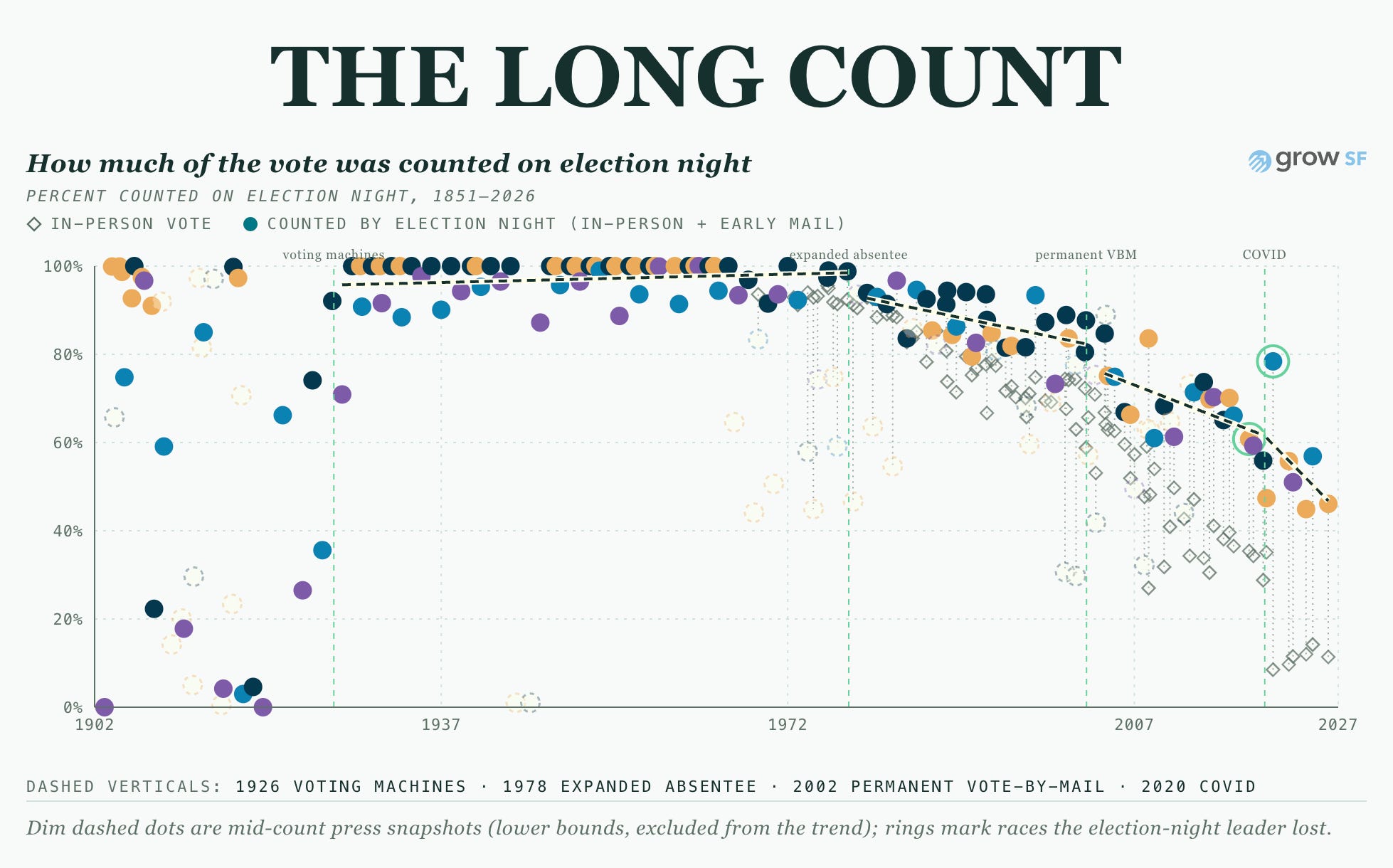
Between 1926 and 2002, San Franciscans would learn the outcome of an election before they went to bed. But in 2002, it started to take longer to learn who won, and today in 2026 it can take days or weeks. 100 years after the adoption of voting machines led to immediate counts, why have our elections gotten slower?
The big change is that almost everyone votes by mail now, and counting mail-in ballots takes longer than counting in-person votes. The signature on each mail-in ballot is manually verified, and the Department of Elections stops counting ballots a day before Election Day in order to print paper voter rolls instead of using electronic voter rolls. In other words, the Department is using outdated technology and processes that haven’t kept up with changing voter behavior.
But the good news is that we can speed up the count without limiting vote-by-mail. Other California counties have already adopted proven fixes, and San Francisco can too.
To create this research report, GrowSF created the first publicly available dataset containing registration counts, in-person voting turnout, and absentee voting data going back to 1849. We searched historic records from the Chronicle archives and the Department of Elections to understand what we knew, and when we knew it, about the outcome of our elections. This significant effort would not have been possible without Anthropic Fable 5, Claude Code, the dutiful reporters at the San Francisco Chronicle, the San Francisco Examiner, the Daily Alta California, and the San Francisco Call, archivists at the San Francisco Public Library, the visionaries behind the Internet Archive and the Wayback Machine, the San Francisco Department of Elections, the registrars who compiled the city’s historical Municipal Reports, the California Secretary of State’s Reports of Registration and Statements of Vote, the U.S. Census Bureau by way of IPUMS NHGIS, the California Voter Foundation’s county counting-speed research, and the county election offices around the state whose practices we compared.
Why the count slowed
There are two main reasons that counting votes in San Francisco has slowed down over the last two decades:
More voters are voting by mail, and they’re voting later than ever
The SF Department of Elections verifies signatures manually instead of using automatic signature verification systems, and they pause the count for two days to print paper voter rolls instead of using electronic voter rolls
Our county-by-county analysis lets us apportion the blame between the two: of the roughly 15 points of election-night share San Francisco lost between 2012 and 2024, the shift to mail voting mechanically explains only about 4. The other 11 come from how the city counts.
Voting by mail
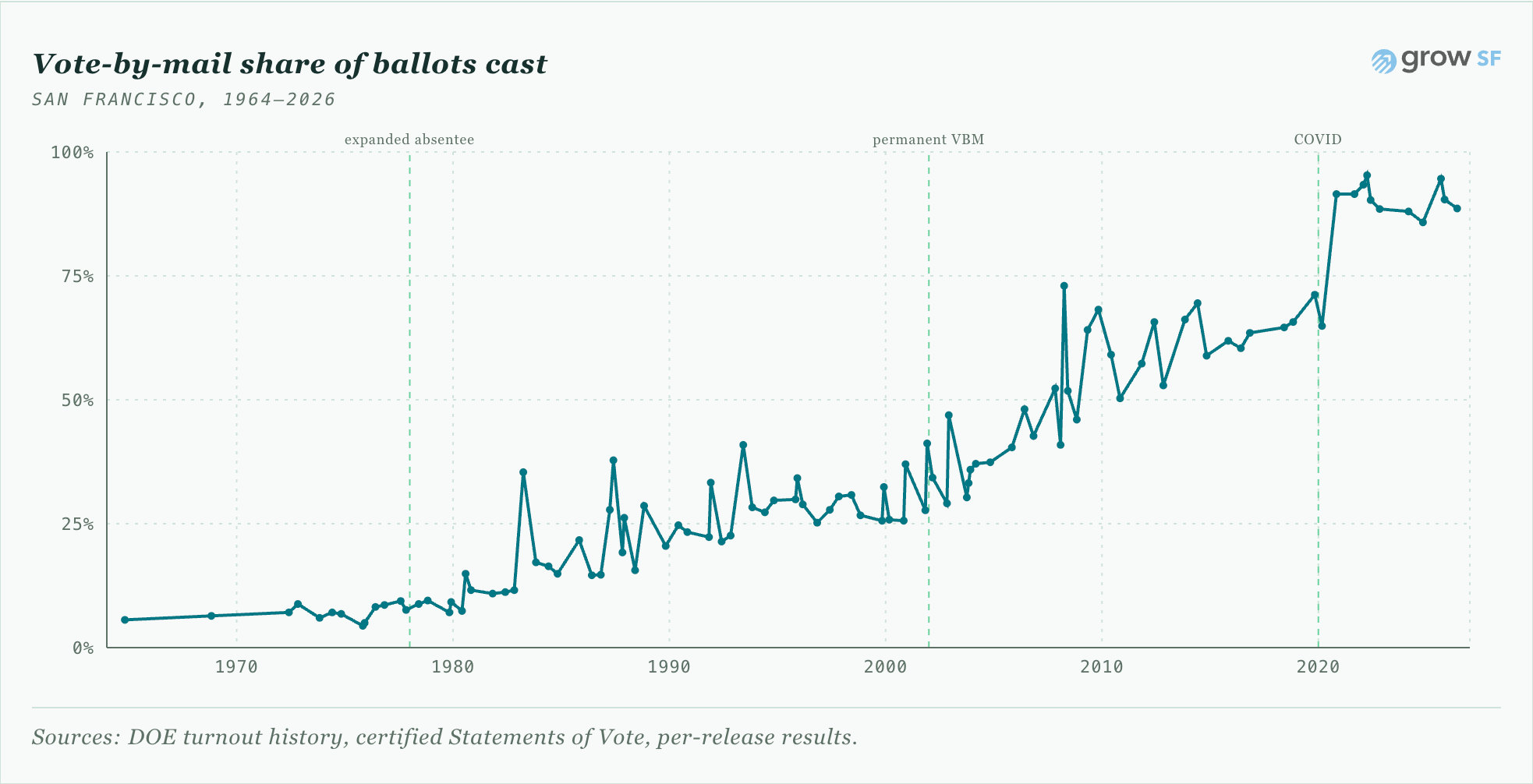
The count’s slowdown is directly tied to the rise of vote by mail, and specifically to VBM ballots arriving on or near election day. In 1978, the state legislature made it much easier to vote by mail (AB 1699), and late-arriving absentee ballots slowly began to erode the election-night count. But the real break came in 2002, when California allowed voters to be “permanent absentee,” meaning they would always get their ballot via mail. By 2020, only about 35% of voters were still voting in person.
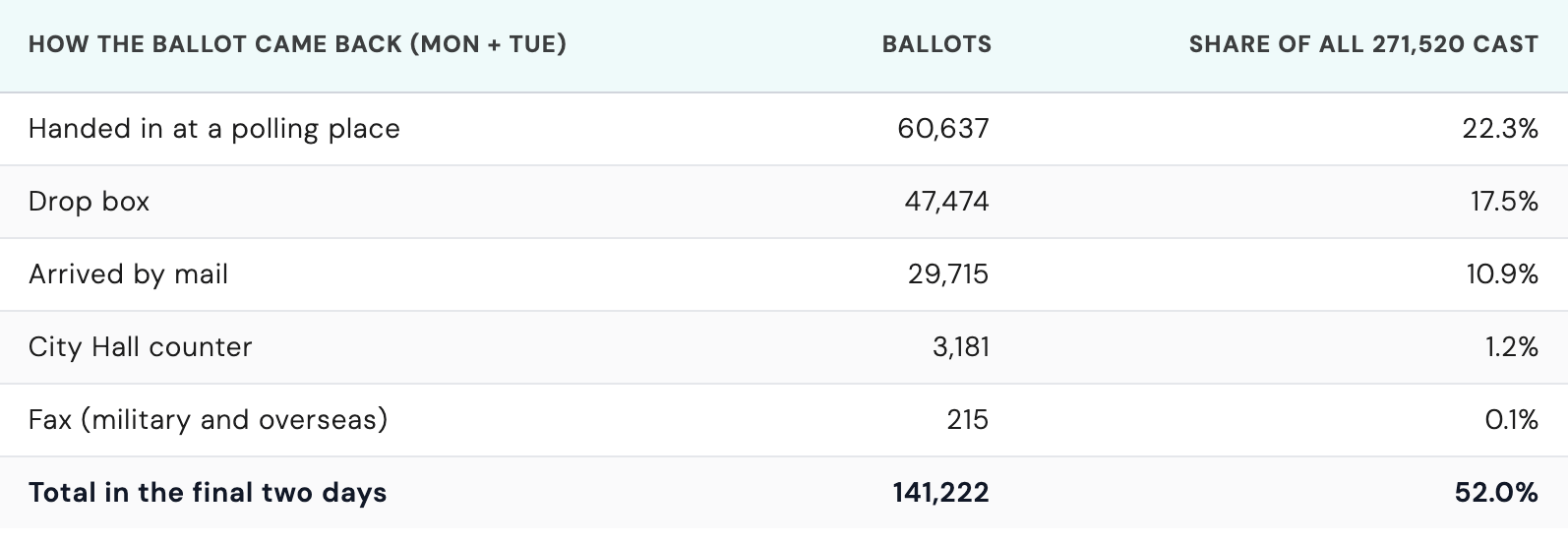
2020’s universal vote-by-mail law (AB 860), prompted by COVID, slowed things down further. The November 2020 election was actually a high-water mark for the speed of the count, because voters mailed in their ballots early. But after that, voters returned to their old habits of voting late. Now the final two days of voting are marked by about half of all ballots coming back, by mail, in drop boxes, or handed in at polling places, and those won’t be counted for many days.
In the June 2026 primary, the final two days looked like this:
And for the election as a whole, in-person voting has become a small minority:

Outdated policy
For 28 days leading up to the election, San Francisco counts mail-in ballots as soon as they arrive. But they stop counting the day before Election Day and don’t resume until the day after. Even if you mail your ballot early, if it arrives on Monday or Tuesday it misses the election-night count. Same story for ballot drop boxes and ballots handed in at polling places. None of these ballots will be counted until Wednesday, and their results won’t be published until Thursday, at the earliest.
The Department stops counting so they can print paper voter rolls and distribute them to the voting precincts across the city. The department flags which voters have already voted so If they show up at their polling place, they’ll be turned away. This guarantees that the 11% of voters who show up at their polling place will be able to vote on a regular (non-provisional) ballot, but it also means that 50% of the count is paused for two days.
In the June 2026 primary, just 46% of ballots were counted on election night.
The policy problem is that the list of voters exists only on paper. Other cities in California have fixed this by using electronic voter rolls so the count never stops and voters are verified in real time.
Why mail ballots are counted so slowly
Every mail ballot must have the signature on its envelope checked against the signature on file, with a human worker comparing the two by eye. That is slow work, and with a sudden deluge of more than a hundred thousand ballots, it’s a real bottleneck in the counting process.
San Francisco has not adopted technology like automatic signature verification to keep pace with the rise of vote-by-mail voting, unlike many other jurisdictions.
Do more people vote? No.
Is a slow count worth it if it means we’ve expanded the franchise and more people can vote? Absolutely. But is that what happened? Our analysis says no.
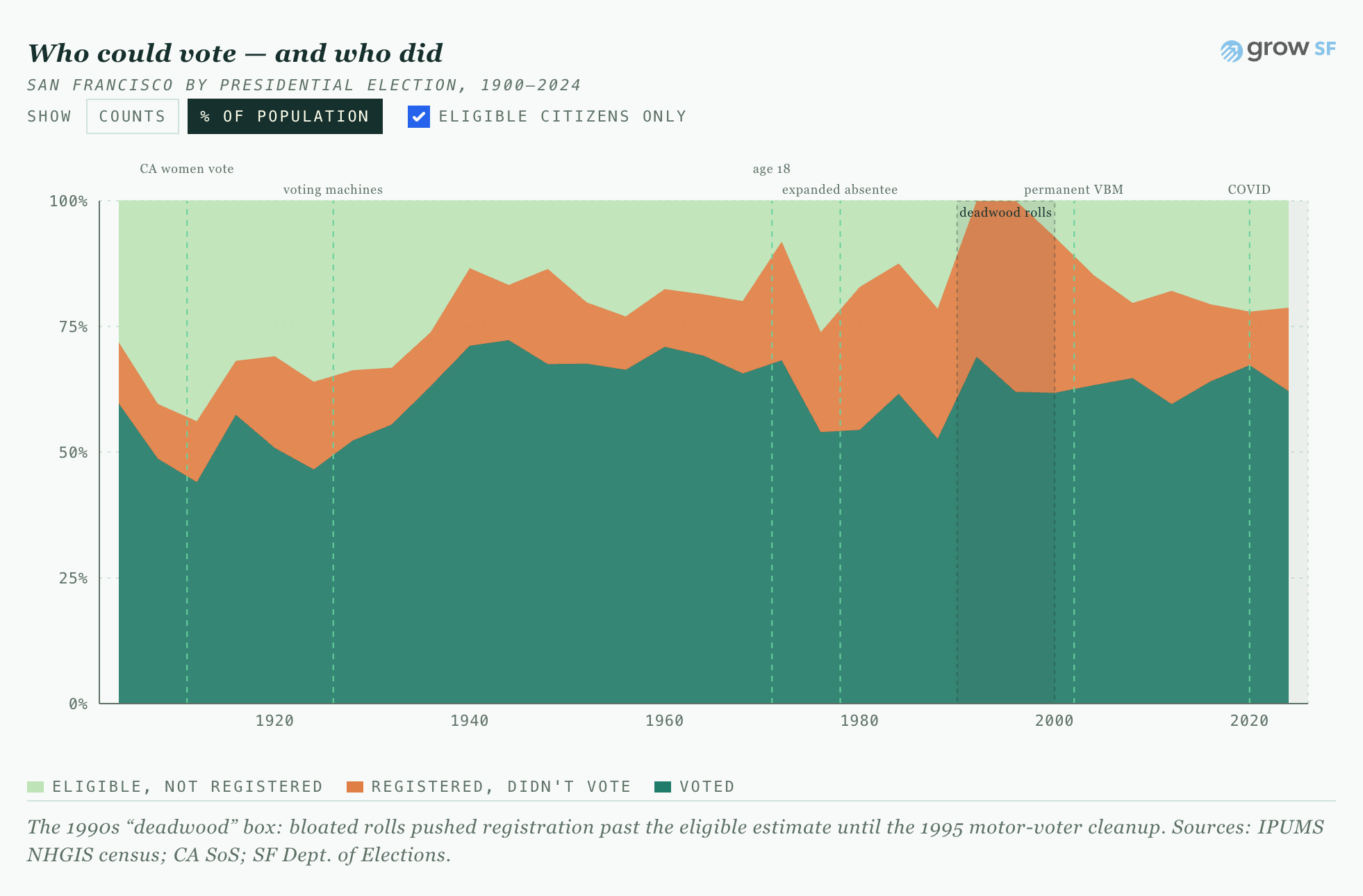
The franchise did not grow in 2020 when we switched to permanent vote-by-mail. It didn’t grow when we allowed permanent absentee registration in 2002. It didn’t grow in 1978, when we made it easier to do vote by mail.
In fact, the share of eligible San Franciscans who are actually registered has held around three-quarters for over a century. And no vote by mail reform has shifted what percent of registered voters actually cast their ballot.
So what would actually speed it up?
Speeding up the count requires a combination of fixes. Better software is part of it, but we also need some policy changes. We can do a lot better, but we still won’t hit 100% election-night counts.
Fix #1: Don’t stop the count
Net election-night increase: 15 points
On election day in June 2026, the Department of Elections was holding 42,107 vote-by-mail ballots it simply wasn’t allowed to process (3,181 handed in at the City Hall counter, 9,211 in Monday’s drop boxes, and 29,715 that arrived by mail on Monday and Tuesday), all because the count pauses to print rosters.
See the data: every June 2026 mail ballot, by date received and return method
Instead of pausing the vote-by-mail count for two days to print a paper list of who has and who hasn’t voted, the Department of Elections should use electronic pollbooks that sync in real time. Each polling place will get a tablet where voters can check in electronically, and verify in real time that they haven’t already voted. This is the single biggest lever to speed up the count, and it is already legal and proven in other counties.
This change would increase election-night counts by as much as 15 points, moving the June 2026 election-night report from 46% toward the low 60s. It would also eliminate the two-day pause, so that ballots returned on Monday and Tuesday would be counted immediately instead of waiting until Wednesday.
Los Angeles, Orange, San Diego, Santa Clara, and San Luis Obispo counties all use e-pollbooks. This is the highest-confidence, highest-payoff fix for the election-night count, and it’s already proven to work.
Fix #2: Sign, scan, and go
Net election-night increase: 10 points
On election day, 60,637 ballots were handed in at polling places. Placer County’s “Sign, Scan & Go” lets a voter cast their mail ballot like an in-person ballot by feeding it straight into the precinct scanner. It cut Placer’s post-election processing by three to four days.
As of the June 2026 primary, 31 of California’s 58 counties offered it, but San Francisco isn’t one of them. A pending bill in the State Senate (SB 1420) would support wider adoption. It won’t catch everyone, since plenty of voters will still drop and go, but it is the only tool that touches that 60,000-ballot polling-place pile.
Say half of polling-place-drop-off voters used sign, scan, and go. That would be 30,000 ballots counted on election night instead of waiting for the post-election canvass, moving the June 2026 election-night report from the low 60s toward the low 70s.
Fix #3: Modernize signature verification
Net election-night increase: 5-30 points
Automated signature verification (ASV) should be used to check every signature, with the high-confidence matches automatically approved. Human workers should only manually review mismatches.
Riverside, San Bernardino, and San Diego use it, among others. ASV is worth doing, but it is not an election-night silver bullet. Signature verification is only as good as the reference set of signatures on file, so if the voter only has a 10 year out-of-date signature from the DMV on file, their ballot will still end up in manual review. But this can be fixed over time: each accepted signature can be folded back into the reference set, so the more ballots that are processed, the better the system gets. ASV is a lever that pays off over time. The Department of Elections could also run signature-update drives, request higher-resolution signatures at the DMV, and proactively reach out to voters with outdated signatures.
Of note, almost no ballots are flagged for review due to mismatched signatures today. In the June 2026 election, just 694 vote-by-mail ballots were flagged for a signature that didn’t match, and the city cured half of them (331). Just 363 out of 241,414 ballots went uncounted due to a signature mismatch. 221 ballots were rejected because the envelope had no signature at all.
Fix #4: Count drop boxes on election night
Net election-night increase: 14 points
The Department of Elections should count ballots in drop boxes on election night, instead of waiting until the post-election canvass. In the June 2026 primary, 38,263 ballots went into drop boxes on Election Day itself (Monday’s 9,211 drop-box ballots are already counted by Fix #1), and none of them were counted until Wednesday. Counting them on election night would move the June 2026 election-night report from the low 70s toward the mid 80s.
Fix #5: Tell voters to vote earlier
Net election-night increase: 5-15 points
The Department of Elections should run a public-education campaign to encourage voters to return their ballots earlier. The June 2026 election saw 52% of ballots returned in the final two days, and that is a big part of why the count is so slow. If voters mailed or dropped off their ballots earlier, more of them would be counted on election night.
Fix #6: Report on Wednesday
Even with those fixes in place, the Department still doesn’t release updated vote counts until Thursday, two days after the election. Simply posting a Wednesday update, using numbers it already has in hand, would show the public a large share of the remaining vote a full day sooner, with no new equipment and no change in law.
It is the cheapest item on this list: a reporting-cadence choice, not a technology. Los Angeles already reports this way: its first canvass update of November 2024 landed the day after Election Day, adding 80,941 ballots to the count, with daily updates after that. And, really, are we going to let LA beat us to the punch on election-night reporting?
Conclusion
Taken together, these six fixes could move San Francisco’s election-night count from 46% in June 2026 to the low-to-mid 90s, and the one-week count from 90% to nearly 100%.
We performed a difference-in-differences study across California’s counties to quantify the effect of adopting these reforms, and the results are encouraging: counties that adopted e-pollbooks, automatic signature verification, and Voter Choice Act vote centers almost all saw meaningful improvements in their election-night counts versus the control. The two counties that adopted vote centers most recently, San Diego in 2022 and Placer in 2024, both beat their own past performance immediately. But Sacramento, which adopted vote centers in 2018 and still saw its night count collapse, showing that the technology only pays off when the operations behind it work.
None of these changes are on San Francisco’s roadmap. We reviewed the Department of Elections’ budget memos, the city’s procurement portal, and the Elections Commission’s 2026 meeting minutes, and none of them turn up a plan to adopt electronic pollbooks, automatic signature verification, or sign-and-scan. When asked directly about automated signature verification, the Department told us it had “previously considered” the technology but “ultimately opted for human review of signatures.”
We will never get a final count on election night, since California lets ballots arrive for a week after election day. But we can do a lot better than 46%. The long count is a choice, and San Francisco can make a different one.
California Voter Foundation study
We developed these recommendations independently. So it really means something that the California Voter Foundation, a nonpartisan group that has tracked the state’s count speed since 2022 through its Close Count Transparency Project, arrived at the same ones. GrowSF’s research report began on June 9th, but on June 25, 2026, CVF published California’s Long Count, an in-depth study built on case studies of Orange, Placer, and San Joaquin counties.
Its list of recommendations matches ours: sign-and-scan, faster signature curing, and voter education that moves ballot returns earlier, plus the things only Sacramento can provide, like funding for ballot-processing equipment, space, and staff ($55.5M in CVF’s budget ask) and a $35M early-voting education campaign. We were surprised that their study even shared a name with ours (The Long Count vs California’s Long Count) - a coincidence.
Addendum: History of SF Voting
Eras
San Francisco has gone through five distinct eras of vote counting.
Hand-count era. (before 1926)
Although voting machines were first tried in 1904, irregularities were found in the election results and the machines were destroyed in the 1906 earthquake & fire. Rather than replace the machines, election officials returned to hand-counting every ballot, often by lamplight. Results were erratic rather than uniformly slow: in light-ballot years the city had most of the result by morning (85% in the 1912 general; 92% in the 1908 primary), but long ballots and heavy turnout could slow the count considerably, like in 1914, with 40-plus state measures on the ballot, and in 1916, the closest presidential race in state history, where barely 3% was counted by the next morning.
Fast-count era (1926 - 1978)
Fast counting arrived with mechanization, led by Joshua H. (Harry) Zemansky, the longtime Registrar of Voters in the early 1900s. Zemansky is unknown now, but was well known and well respected at the time, and is responsible for bringing San Francisco’s elections into the modern era.
At the 1922 convention of county clerks in Los Angeles, Zemansky advocated to “substitute the voting machine in place of the present methods of casting ballots“. By 1923, Zemansky had ordered 52 machines (though the Chronicle reported it was actually 100 machines for 52 precincts), deployed 500 machines by November 1925, and rolled them out to every one of the 600+ precincts by 1926.
The difference was immediate, and the contrast was visible the same year the rollout was half-finished. Because a lever machine tallies each vote as it’s cast, “the counting of the ballots was done in each polling place rather than at a central point,” and officials in the machine precincts “were done with their tasks immediately after the close of the polls” — while the precincts still using paper ballots “required considerable time” (San Francisco Chronicle, November 4, 1925). As soon as machines replaced hand-counted paper across the city, San Franciscans started learning the outcome on election night: “The machines were a great success, giving the result at 8 o’clock on election night, while in the paper ballot booths officials worked until the early morning hours” (San Francisco Chronicle, November 13, 1925)
Absentee early voting era (1978 - 2002)
In 1978, the state legislature made it much easier to vote by mail. Until then, a voter had to specify a qualifying reason (illness, absence from the precinct on Election Day, physical handicap, a conflicting religious commitment, or living more than 10 miles from their polling place) to get an absentee ballot at all. But AB 1699 (Chapter 77, Statutes of 1978 [Lehman]) “delete[d] the requirement that a registered voter specify a reason for the request for an absentee ballot” and guaranteed that an absentee ballot would be “made available to any registered voter.”
At the beginning of the era, these absentee voters typically voted early and their ballots were already counted by election night. But by the 1990s they were voting later and later, and the election-night count slowly began to erode, though San Franciscans still went to bed knowing the outcome.
Permanent vote-by-mail era (2002 - 2020)
In 2002, California opened its first permanent absentee voter roll: register once and you’d automatically receive a mail ballot in every election. By 2020, only about 35% of voters were still voting in person.
This was a major change in voter behavior, and it immediately caused a noticeable and persistent slowdown in the count. People started to get accustomed to receiving their ballot early, waiting to fill it out, and mailing it in later and later. Election nights below 75% counted, a rarity in the previous three-quarters of a century, became the norm: since 2006, only the all-mail November 2020 election has cleared that bar, and the slide continued for two decades.
Slow-count era (2020 - present)
Nearly one hundred years after San Francisco entered its fast count era with mechanical voting machines, in 2020 the slow count era began.
Two things define this era:
Almost everyone votes by mail, and counting mail ballots takes a long time due to manual signature verification.
About half of all voters return their ballot in the final two days of voting.
The COVID pandemic in 2020 forced a change to universal vote-by-mail, which slowed the count dramatically. Not only is counting a mail ballot slow due to manual signature verification, but anyone who casts their ballot in the final four days of the election wouldn’t have their ballot counted until the day after Election Day, at the earliest. And because about half of all voters return their ballot in those final two days, the end of every election is now marked by a deluge of ballots that won’t be counted for many days.
As of the June 2026 primary election, just 46% of ballots were counted on election night.
How votes were counted, by era
Until 1926: Hand-counted paper ballots, tallied by clerks precinct by precinct, late into the night.
1926–1960s: Mechanical lever voting machines — adopted in 1923 (upheld in Ashe v. Zemansky), citywide by 1926. Each machine tallied votes at the precinct, so totals were read off the counters at the close of polls.
1960s–1990s: Punch-card ballots, machine-tabulated — the system behind 1995’s “chad-jam” count.
2000s: Punch cards were decertified after the 2000 Florida recount; the city moved to optical-scan paper ballots, and to ranked-choice tabulation in 2004.
Today: Optical-scan paper everywhere: precinct scanners on Election Day, and high-speed central scanners for the mail ballots — each read only after its signature is verified, at the central office.
Registration and turnout
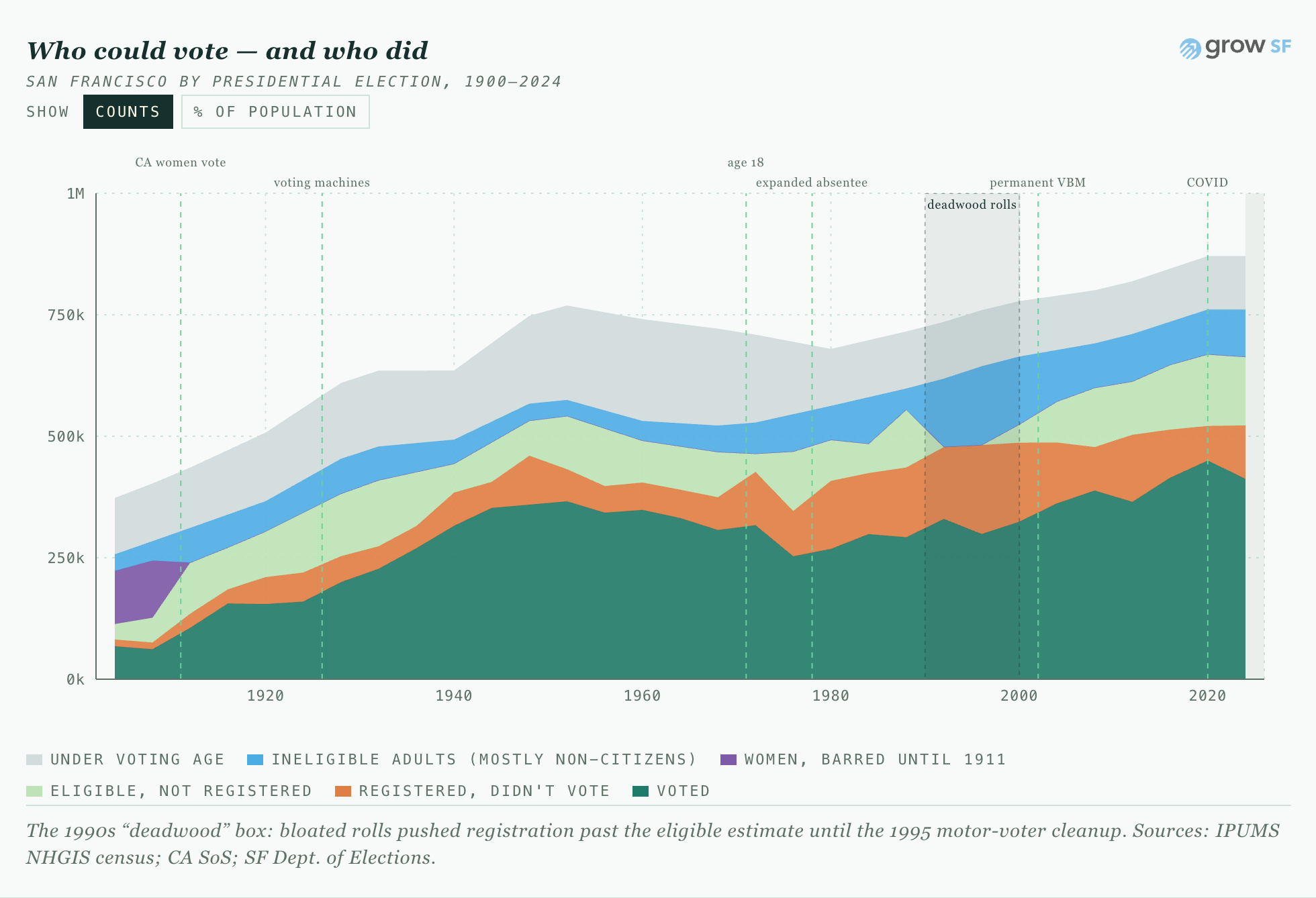
Slightly more people are registered, and slightly more are voting, but it hasn’t changed much since 1948. And no vote by mail reform has shifted what percent of registered voters actually cast their ballot.
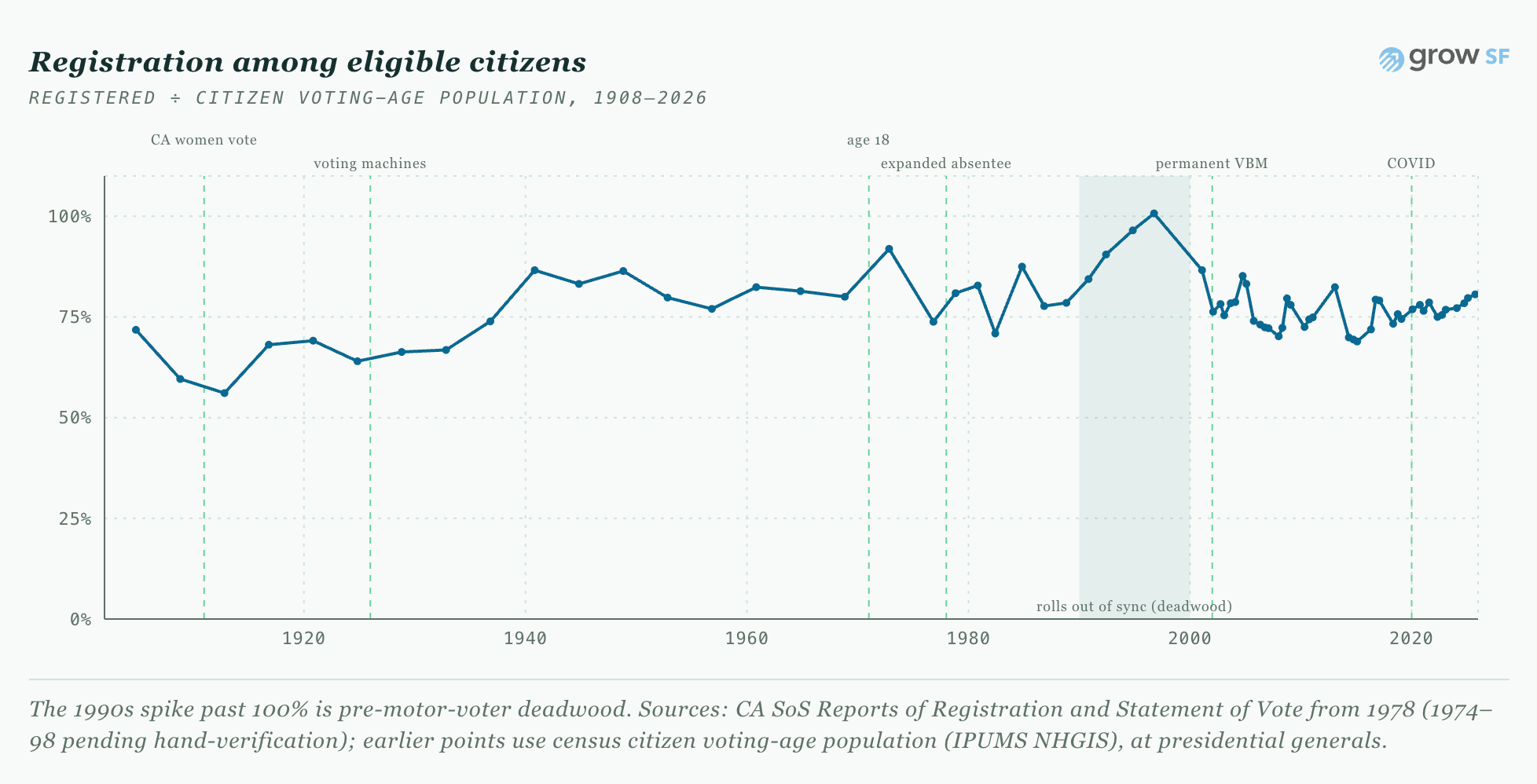
The share of eligible San Franciscans who are actually registered has held around three-quarters for over a century. One thing to note, though: in the 1990s the share of registered voters briefly exceeds the eligible electorate. That’s the “deadwood” era of bloated rolls, before the 1995 federal “motor-voter” law forced a cleanup to remove people who were no longer correctly registered after they moved out of the jurisdiction.
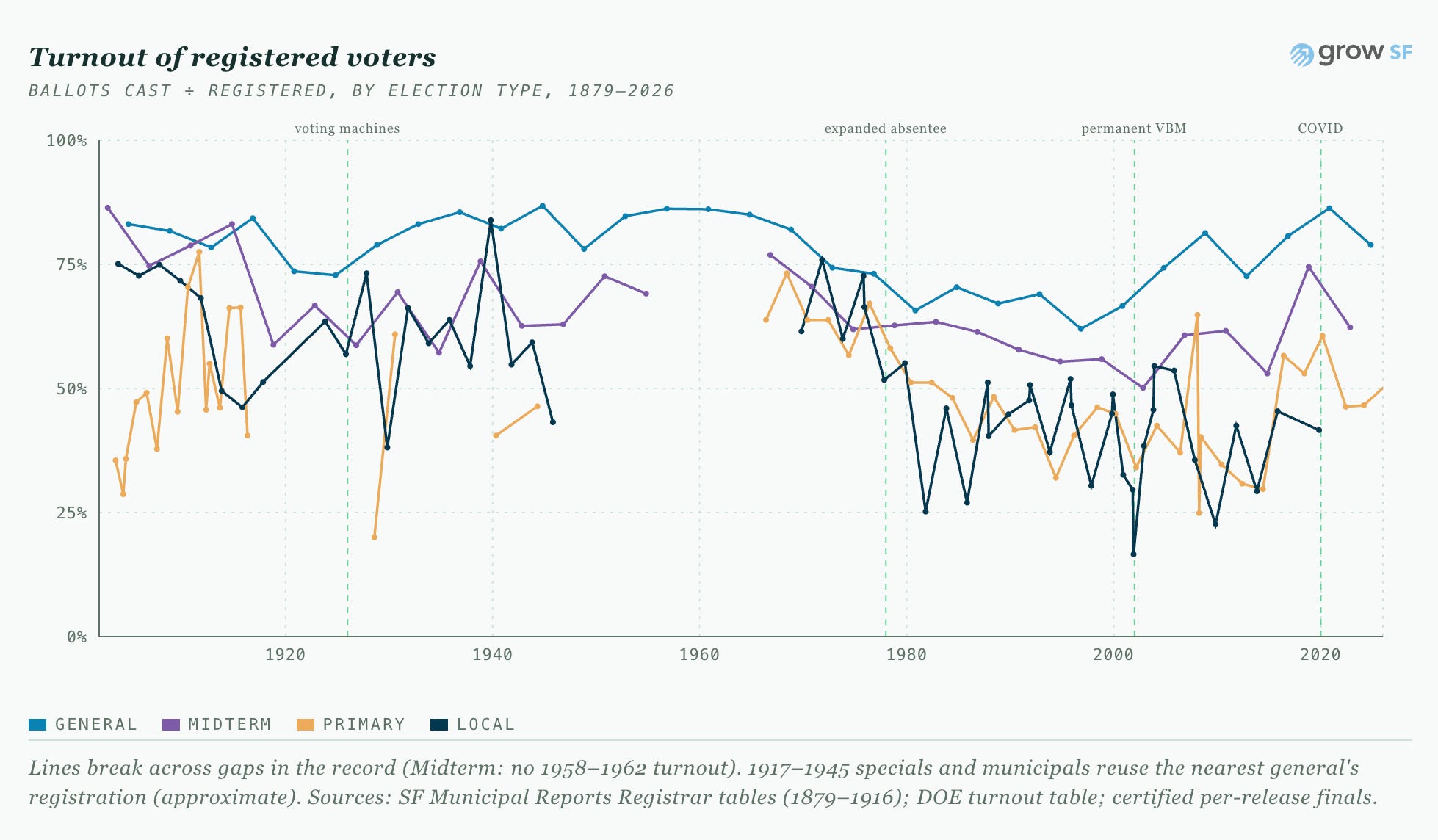
Turnout is a slightly different story. You can see in the chart above that post-2002’s permanent absentee voter roll, turnout in the general election does go up, but it’s confounded by a new political environment with always-on news, social media, and never-ending political campaigns. So it may be more attributable to the media environment, or even who’s on the ballot, rather than how people are voting.