

What You Need To Know
Here’s what happened around the city for the week of August 30, 2026:
- Lurie Will Tie Homelessness Contracts to Results
- Fielder Proposes Minimum Unpaid-Rent Threshold for Evictions
- Manny Yekutiel Proposes a 24-Mile Citywide Subway
- Urban Alchemy Study Finds Fewer Police Reports, Not Necessarily Less Crime
- Vacant Storefront Tax Now Hits Just 27 Properties
- Sixty Shelter Cabins Sit Empty After Recovery Site Falls Through
Election Countdown
59 days until the November 3 SF General Election — the one that decides whether our commonsense Board majority survives. Read the GrowSF Voter Guide for the November election
GrowSF’s endorsements (some more coming soon!):
San Francisco
Assessor-Recorder: Joaquin Torres
Supervisor, District 2: Stephen Sherrill
Supervisor, District 4: Alan Wong
Supervisor, District 6: Matt Dorsey
Supervisor, District 8: Manny Yekutiel
Supervisor, District 10: Theo Ellington
Board of Education: Autumn Brown Garibay, Phil Kim, Tim Tung
City College: Erwin Tam, Elijah Ball, Monroe Lace
City College (partial term): Ruth Ferguson
BART: Sara Barz
California
Governor: Xavier Becerra
Lieutenant Governor: Fiona Ma
Secretary of State: Shirley Weber
Controller: Malia Cohen
Treasurer: Eleni Kounalakis
Attorney General: Rob Bonta
Insurance Commissioner: Benjamin Allen
Board of Equalization: John Pimentel
Superintendent: Coming soon
State Assemblymember, District 17: Matt Haney
State Assemblymember, District 19: Catherine Stefani
Federal
House of Representatives, District 11: Scott Wiener
Ballot Measures
✅ Yes on Prop A: Charter Changes Affecting Various City Departments and Commissions
❌ No on Prop B: Establishing a Municipal Finance Corporation and a Public Bank
✅ Yes on Prop C: Contributions to the Housing Fund
✅ Yes on Prop D: Changes to Ballot Measure Process
✅ Yes on Prop E: City Administrator’s Authority and Changes to City Contracting
✅ Yes on Prop F: Changes to Executive Branch Management
❌ No on Prop G: Allowing Private Vehicles on the Great Highway in Sunset Dunes Park
✅ Yes on Prop H: Parcel Tax to Fund Public Muni Operations
❌ No on Prop I: Changes to Real Property Transfer Tax
Decision coming soon on Prop J: Foreclosure Tax
State measures coming next week!
Read our full endorsement rationale in the GrowSF Voter Guide.
Lurie Will Tie Homelessness Contracts to Results
Published August 31, 2026

The Facts
San Francisco will re-bid all homelessness-service contracts over several years and tie funding more closely to results, reports Alyce McFadden at the Chronicle. Currently, most contracts reimburse providers for expenses without clearly connecting costs to outcomes.
The Context
City audits have identified this problem for years. A 2023 Civil Grand Jury report found that 40% of contracts reviewed mislabeled activities as outcomes. A 2024 performance audit found $73 million of $180.6 million in supportive-housing contract budgets went unspent in fiscal year 2021–22, while performance measures were applied inconsistently. We have previously documented how nonprofit spending doubled while oversight lagged.
The GrowSF Take
This is such an obviously good move that we wonder why it has taken this long to get here. Every city contract should have clear deliverables, and if we aren’t getting what we’re paying for, then we should end the contract.
Fielder Proposes Minimum Unpaid-Rent Threshold for Evictions
Published September 4, 2026

The Facts
Supervisor Jackie Fielder has a proposal to protect renters from eviction. Her minimum-debt ordinance would bar nonpayment evictions until a tenant owes more than one month of federal fair market rent for a comparable apartment, Yujie Zhou reports at Mission Local. The debt would remain collectible.
The current thresholds are $2,485 for a studio, $2,977 for a one-bedroom, and $3,604 for a two-bedroom.
The Context
Other cities have similar policies. Oakland requires at least one month of federal fair market rent to support a nonpayment eviction, and Berkeley adopted the same basic rule.
The ordinance is co-sponsored by Supervisors Myrna Melgar, Shamann Walton, Connie Chan, Chyanne Chen, Bilal Mahmood, and Danny Sauter.
The GrowSF Take
Fielder is right to stop landlords from using a few unpaid dollars to dislodge tenants. Eviction is an extreme response to a trivial, accidental, or even temporary shortfall. The legal text is short and simple, and we support it.
San Francisco must keep making it easier to build new homes, and we should keep finding ways to help people struggling to stay here.
Manny Yekutiel Proposes a 24-Mile Citywide Subway
Published September 3, 2026

The Facts
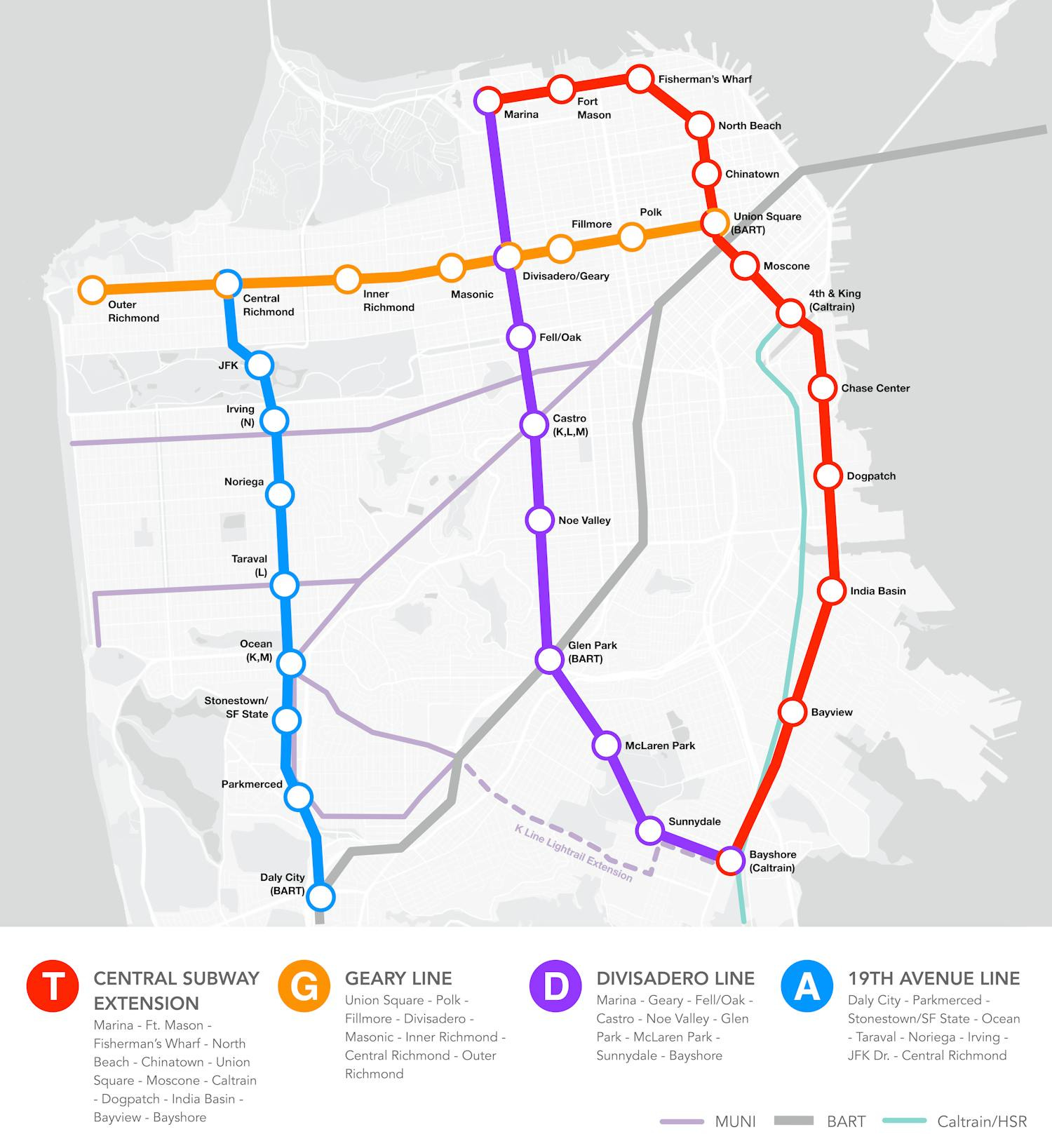
District 8 candidate Manny Yekutiel has proposed a 24-mile subway network with four lines: a fully underground T line extended north to the Marina and south to Bayshore, plus new lines under Geary Boulevard, Divisadero Street, and 19th Avenue.
At San Francisco’s recent construction cost of $1.15 billion per mile, Yekutiel estimates the network would cost $27.5 billion. He says standardized stations, automated trains, continuous construction, and a dedicated building authority could cut that to $350 million per mile, or $8.4 billion total. Joe Fitzgerald Rodriguez, John Mulholland, Omar Rashad, and Maggie Angst at The Standard reported on the proposal.
The Context
The San Francisco County Transportation Authority is already studying a roughly 10-mile Geary and 19th Avenue subway estimated at $20 billion to $30 billion. Yekutiel’s $8.4 billion citywide estimate therefore depends on cutting per-mile costs by nearly 70%, not ordinary efficiencies.
San Francisco’s Central Subway cost $1.95 billion for 1.7 miles — about $1.15 billion per mile, against a global average of $406 million per mile across the 755 lines tracked by NYU’s Transit Costs Project. Even among American tunneled projects, which average roughly $570 million per mile versus $346 million abroad, that is about double the going rate.
The GrowSF Take
It’s a wonderful vision, and we need more Supervisors with the vision to do big things. But given the high price tag and long timeline, let’s start with driverless rapid buses on these same lines. We can get 50% of the benefit for 10% of the cost and meaningfully improve the lives of tens of thousands quickly.
Urban Alchemy Study Finds Fewer Police Reports, Not Necessarily Less Crime
Published September 3, 2026

The Facts
A new peer-reviewed study associates Urban Alchemy staffing with 20% fewer police-recorded incidents at 41 intersections, but it cannot distinguish a net reduction in crime from changes in reporting or crime moving to other streets. Property crime showed no change.
The Context
The study compared recorded police incidents at intersections with and without Urban Alchemy workers. If a worker moves criminal activity a few blocks away, the study may record a reduction at the staffed corner even though the activity was merely relocated.
The authors tested this by removing immediately adjacent intersections from the comparison group, and the daytime effect became statistically insignificant.
In January, San Francisco awarded Urban Alchemy a $22.51 million contract through June 2027.
The GrowSF Take
Overall we’re glad that Urban Alchemy exists. A consistent street presence and overdose response can improve daily life for residents in the area.
But this study cannot prove if they actually reduce crime or just move it around.
The lesson for City Hall should be that outsourcing basic safety services to nonprofits isn’t a silver bullet. We need to build internal institutional capacity, instead.
Vacant Storefront Tax Now Hits Just 27 Properties
Published September 4, 2026

The Facts
Due to a recent law change, only 27 storefront vacancies were subject to San Francisco’s commercial vacancy tax in 2025, down from 241 in 2024, when it collected just $2.74 million, according to Delilah Brumer at the San Francisco Chronicle. The change covers every eligible storefront in a commercial district where a City construction project lasts more than 180 days. It turns out that this covers almost every commercial zone.
The Context
Voters approved the tax in 2020 to discourage landlords from intentionally awaiting higher rents. A storefront vacant more than 182 days can owe a frontage tax of $250 to $1,000 per linear foot, depending on how long it remains empty.
But vacancies also come from weak retail demand and San Francisco’s own rules. GrowSF’s retail vacancy research found that the City requires unwanted ground-floor retail in many new buildings while restricting conversion of empty shops into housing, offices, restaurants, or other useful spaces.
The GrowSF Take
We will not mourn the disappearance of this tax. It treats every vacancy as landlord greed when City Hall often blocks tenants, bans alternative uses, and mandates excess retail space. The Board should set the tax rate to zero, then make storefront conversions legal by right.
Sixty Shelter Cabins Sit Empty After Recovery Site Falls Through
Published September 4, 2026

The Facts
Sixty city-owned shelter cabins have sat unused in the Bayview for nearly a year. But the proposed recovery site at 428 11th Street was not workable: it potentially needed a Pacific Gas and Electric service upgrade, officials considered temporary power and opening at partial capacity, and the landlord demanded a firm three-year lease without a short-term exit clause, reports Maggie Angst at The Standard.
The city canceled the plan after spending $219,000. GrowSF also learned that available state operating funds did not support the recovery programming intended for the site.
The Context
Mayor Daniel Lurie pledged to add 1,500 shelter and treatment beds within six months of taking office. The city’s expansion plan included transitional housing, stabilization centers, sober housing, and residential treatment, reflecting the need for placements that address the intersection of addiction and homelessness.
The cabins are one possible tool. They offer more privacy than congregate shelters, but they still require a suitable site, adequate utilities, responsible lease terms, operating funds, and services.
The GrowSF Take
We’re disappointed all around. Sixty usable cabins have sat empty for nearly a year while people remain on the street.
The 11th Street site was not viable, but that cannot be the end of the effort. Private cabins do not work for everyone, but they help some people. The Lurie administration should find a technically sound site and an operating model that puts them back to use.
Paid for by GrowSF Voter Guide. Not authorized by any candidate, candidate’s committee, or committee controlled by a candidate. Financial disclosures are available at sfethics.org.