

What You Need To Know
Here’s what happened around the city for the week of November 16, 2025:
- Connie Chan Enters Race For Congress
- Dog Shooting Exposes SF’s Broken Dangerous Dog System
- Chan’s Red-Tape Ordinance Voted Down
- Ocean Beach Safeway Redevelopment Will Add 526 New Homes
Recent & upcoming openings:
- Chicken Fried Palace Is the Diner of Your Dreams
- Quack House Reboots Hing Lung Co
Research:
- Too Many Ballot Measures: Why San Francisco Needs To Fix Its Charter
Connie Chan Enters Race For Congress
Published November 20, 2025

The Facts
District 1 Supervisor Connie Chan has entered the race to replace Nancy Pelosi, according to Joe Fitzgerald Rodriguez, Gabe Greschler, and Josh Koehn at The Standard. Chan is one of the most strident anti-development voices on the Board of Supervisors.
The Context
Pelosi’s retirement creates a rare open seat for San Francisco - she held the seat for 40 years. State Senator Scott Wiener and former AOC chief of staff Saikat Chakrabarti are already in the race. Locally, Chan has built her brand as a skeptic of adding new housing on the west side. She has been a vocal critic of Mayor Daniel Lurie’s Family Zoning Plan, pushing carve-outs and exclusions for much of the Richmond and aligning with anti-growth groups trying to block taller, denser buildings along corridors like Geary and Clement.
Chan’s district has long failed to do its part on housing, having built just 2 new homes in all of 2024 (28 total new units once ADUs are included in the count), according to SF Planning’s 2024 Housing Inventory. This contrasts with 1,597 net new homes citywide.
About 6,870 children were born in San Francisco in 2024, per preliminary state data summarized by Christian Leonard at the Chronicle. If we very roughly assume the Richmond accounts for about one-eleventh of city births, that suggests on the order of 600 babies born there in a single year versus only a few dozen net new homes. This is a rough estimate, but the scale of the mismatch is clear and we’re left wondering where all these children will live as they grow up, when their own neighborhood refuses to make room for them.
The GrowSF Take
Chan’s record on growth would deepen, not solve, San Francisco’s housing crisis. At every major juncture, she has worked to water down or delay upzoning that would legalize more homes in exactly the high-resource, transit-served, family neighborhoods she represents, siding with west-side preservation groups determined to freeze the built environment in place rather than welcome new neighbors. The Standard’s coverage of Family Zoning negotiations underscores how often Chan’s amendments aim to pull land out of the rezoning map.
GrowSF believes San Francisco—and the country—will be better served by pro-housing, pro-growth problem-solvers than by elevating one of City Hall’s most reliable votes against progress.
Dog Shooting Exposes SF’s Broken Dangerous Dog System
Published November 20, 2025

The Facts
On Nov. 9, an off-leash husky mix dog allegedly bit a person on Market Street and lunged at an SFPD officer who responded to the attack. A body-camera and surveillance video released by SFPD and interim Chief Paul Yep shows Officer Joseph Toomey confronting the dog’s owner, Trusten Eaton, near Fourth and Market streets. When officers moved to arrest Eaton and told him to control the dog, the animal twice charged Toomey, as seen in the bodycam footage. The officer fired one round at the dog when it charged, striking it in the shoulder, and one at Eaton when he threw a bottle, striking him in the leg; both were hospitalized with non-life-threatening injuries and are expected to recover.
But this story is bigger than a shooting, it’s that it should have been avoided entirely. Over 800 dog bites have been reported this year alone, yet our “canine court” has been effectively shut down for months, leaving dangerous dogs on the streets without consequences.
The Context
More than 800 dog bites were reported in San Francisco in the first nine months of 2025, putting the city on track to surpass last year’s record of 868 reported bites, according to an investigation into rising dog attacks and suspended canine court hearings by Jennifer Wadsworth at The Standard.
While attacks are up, “canine court” hearings fell from 159 in 2020 to just 32 so far in 2025 and stopped entirely after June 24, leaving at least 21 completed investigations and roughly two dozen additional cases in limbo.
A 2018 civil grand jury report had already flagged serious problems with how San Francisco managed dangerous dogs, including inconsistent application of Health Code standards and inadequate support for the one officer assigned to the work. SFPD has updated its dog-complaints policy to step up leash-law enforcement, but those moves are landing on top of a non-functioning adjudication system.
The GrowSF Take
San Francisco has allowed a predictable public-safety problem to fester. The Market Street shooting was chaotic and disturbing; independent investigations must scrutinize whether the shooting was justified. But the failure is with policy, not police tactics.
City Hall has tolerated record dog-bite numbers while letting canine court grind to a halt, leaving victims, officers, and responsible owners without a clear path to consequences for dangerous animals. The city needs a fully funded, transparent hearing system; a single accountable lead agency; and consistent, data-driven enforcement of leash and bite laws. Dangerous-dog cases should be resolved quickly—with training, muzzling requirements, or euthanasia of truly vicious animals—long before they escalate into attacks on innocent people and pets.
Chan’s Red-Tape Ordinance Voted Down
Published November 20, 2025

The Facts
Supervisors Mahmood, Sauter, Sherrill, and Dorsey voted down Supervisor Connie Chan’s ordinance to require a special “conditional use authorization” before any new business could lease a storefront previously occupied by a legacy business, according to Alyce McFadden at the San Francisco Chronicle. The measure also would have shortened eligibility for the Legacy Business Registry from 30 to just 15 years in operation.
Because the Planning Commission had already recommended disapproval, the ordinance needed a two‑thirds supermajority to pass.
City planners, the Planning Commission, and several small business organizations argued the proposal would increase bureaucratic hurdles, risk more vacant storefronts, and mainly benefit well‑lawyered operators rather than truly vulnerable mom‑and‑pop shops.
The Context
San Francisco’s Legacy Business Program already gives long‑standing businesses (typically 30+ years) access to marketing help, rent stabilization grants, and other support through the Office of Small Business’s Legacy Business Program. Meanwhile, Mayor Daniel Lurie’s PermitSF and initialize has been cutting permitting delays and costs. Chan’s ordinance was in direct opposition to a pro-small-business agenda.
An October staff analysis presented to the Planning Commission warned that Chan’s ordinance would “create the appearance of protecting Legacy Businesses without delivering meaningful benefits.”
The GrowSF Take
Requiring yet another conditional‑use hearing any time a legacy business closes is the wrong tool. Making it harder for a new business to fill a vacant space, just because that space used to hold an old business, simply makes zero sense.
San Francisco should absolutely support long‑standing businesses, but with predictable taxes, lower fees, and fast, low‑cost permits, and not with legal hoops that favor insiders and lawyers over actual shopkeepers. Killing this ordinance was the right call; now the Board should pair Family Zoning with targeted, by‑right support programs that keep beloved institutions thriving while making it easier, not harder, for the next generation of small businesses to open.
Ocean Beach Safeway Redevelopment Will Add 526 New Homes
Published November 19, 2025

The Facts
Safeway’s Outer Richmond store at 850 La Playa Street is slated for a temporary closure while Safeway and developer Align Real Estate pursue a major redevelopment to turn the one‑story store and surface parking lot into two eight‑story buildings containing 526 rental homes, a larger Safeway, and new parking for residents and shoppers. Of those homes, 68 would be reserved for low‑ and very‑low‑income households. Safeway says all current employees will keep their jobs and that on‑site employment will grow by about one‑third once the new store opens, according to reporting by Laura Waxmann at the Chronicle.
The Context
Under current zoning, the maximum height at 850 La Playa is 40 feet (about four stories). Mayor Daniel Lurie’s proposed Family Zoning plan would rezone the site to 65 feet as part of a citywide push to allow more homes in high‑opportunity west‑side neighborhoods. But Align is relying on state density‑bonus laws to go to about 85 feet and secure ministerial, by‑right approval in exchange for on‑site subsidized units, effectively bypassing much of local discretionary control even as Supervisor Connie Chan tries to carve 850 La Playa and other Outer Richmond parcels out of the Family Zoning map and layer on extra review.
The GrowSF Take
If you’ve never lived directly above a grocery store, you might not realize how incredibly convenient it is. Having a full-service supermarket just an elevator ride away makes daily life so much easier, especially for families with kids.
This is a no-nonsense redevelopment and we’re all for it. Take note that this project bypasses local restrictions in exchange for more height and more low-income units. A great trade, we think!
Recent & upcoming openings
A great city is constantly changing and growing, let’s celebrate what’s new!
Chicken Fried Palace Is the Diner of Your Dreams

WHEN: Opens today, Saturday November 22
WHERE: 2240 Mission (the former Wes Burger spot)
Sometimes you just need some comfort food, and sometimes you need really nice comfort food. Chicken Fried Palace is ready for both, and you’ll enjoy every bite. Astrid Kane reports in the Standard that it’s the new project from Michelin-starred chef Seth Stowaway (of Osito), alongside partners Cole Jeanes of Memphis and Gabrielle Pabonan who previously worked with the Thomas Keller Group.
If you’ve never had a southern-style chicken-fried steak, you need to drop what you’re doing and head over. And for the gluten-free folks, there are purportedly some gluten-free breading options so you can still get your fry on.
Quack House Reboots Hing Lung Co.

WHEN: Opened yesterday, Friday Nov 21
WHERE: 927 Post
Famed roast duck restaurant, Hing Lung Co., closed its doors last year and everyone’s been hoping it would come back in all its glory. Many (like me!) have gotten our fill via their Bernal derivative, “Go Duck Yourself,” but now Quack House will bring back Hing Lung’s by-the-pound orders of impeccable roast duck to 927 Post, according to Mario Cortez at The Chronicle.
Research
Too Many Ballot Measures: Why San Francisco Needs To Fix Its Charter
Published November 17, 2025

Tired of ballots crammed with dozens of measures you barely understand? You’re not alone.
Every election, our ballots are bloated with local propositions—often 15 or more in a single election! They touch on everything from housing and transit, to street trees, to police staffing, and overtime or retirement benefits for EMTs and nurses. We’re asked to weigh in on confusing and highly technical issues that shouldn’t need our vote at all. After all, didn’t we elect people to handle this?
This chaos of constant ballot measures isn’t just tiring, though. It’s also hurting our city and wasting millions of dollars. But it doesn’t have to be this way. Let’s fix it.
Ballot Overload
San Francisco’s ballots have become notoriously overcrowded. In November 2024, San Franciscans faced 15 local measures, while voters in nearby Oakland had just 3 and San José only 1.
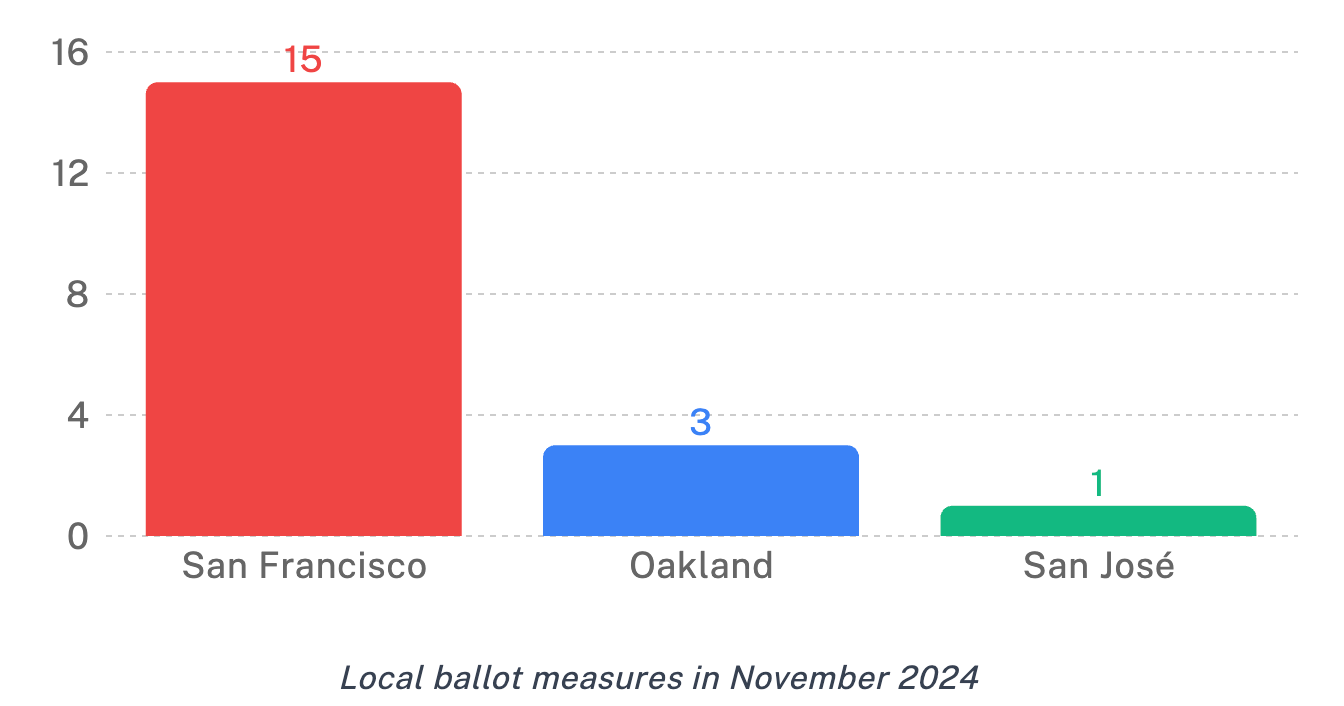
This glut of propositions leaves voters with homework that other cities simply don’t require.
What’s worse, many of these propositions didn’t even need to be on the ballot in the first place. According to SPUR, a local good-government group, “Since 2015, 29% of measures submitted to San Francisco voters required no voter approval and could have been adopted legislatively.”
In other words, our ballots are cluttered with work that City Hall should have done itself.
GrowSF started because we were fed up with this ballot chaos. Every election, we brace ourselves for the marathon of reading through dozens of pages of fine print, trying to decipher legal jargon and conflicting claims from competing campaigns. But you shouldn’t need a secret decoder ring to understand what you’re voting on!
Why Does SF Legislate at the Ballot Box?
There are three structural flaws in San Francisco’s laws that makes it easier to legislate at the ballot box than in the Board of Supervisors chambers:
A minority of Supervisors (4 out of 11), or the Mayor alone, can place measures directly on the ballot, bypassing the usual legislative process.
The signature requirement to qualify citizen initiatives is absurdly low: just 2% of registered voters compared to up to 20% in other California cities (With around 500,000 voters, that’s just 10,000 signatures).
A state law intended for large counties with many cities also applies to SF by itself. This allows a simple majority of Supervisors to introduce charter amendments, akin to constitutional amendments, without consent of the Mayor.
Passing a law is supposed to involve working it through the Board of Supervisors with hearings, public input, and amendments, leading to a majority vote plus the Mayor’s approval (or a veto override). That process is designed to encourage debate, compromise, engagement with experts, and careful refinement of policy. But our system provides a tempting shortcut: a minority of Supervisors, or even just the Mayor alone, can put new laws on the ballot, bypassing the usual legislative process. No majority, no hearings, and no experts required.
State law lets counties propose charter amendments with a simple majority. That makes sense because those counties include many cities, each with different interests that must be negotiated. But San Francisco is unique: we are the state’s only combined City & County, yet the same rule still applies to us. And since our Supervisors represent individual neighborhoods rather than whole cities, a small group of parochial interests can control the process and rewrite San Francisco’s constitution without a Mayoral veto or the normal legislative process.
But it’s not just those flaws. The signature requirement to qualify citizen initiatives is absurdly low: just 2% of registered voters. Other cities across California require signatures from 8% to 20% of their electorate to qualify. This means that any half-organized group in San Francisco can gather enough signatures to put their half-baked ideas on the ballot.
In short, it’s easier to lob a proposal onto the ballot than to govern through City Hall. As SPUR observes in its “Charter for Change“ report, “the charter allows shortcuts not found in other cities,” encouraging political fights at the ballot box instead of negotiated solutions in City Hall.
By the Numbers
Since 1996, when San Francisco adopted its current charter, voters have been asked to vote on 403 different local ballot measures. Some of those were legally required to go to the ballot, like the 46 bonds and 46 taxes we’ve voted on. But what about the rest?
San Francisco voters have been burdened with deciding on 29 meaningless “policy declarations” that have no force of law, 152 charter amendments, and 120 ordinances that skipped the legislative process. The 120 ordinances came from...
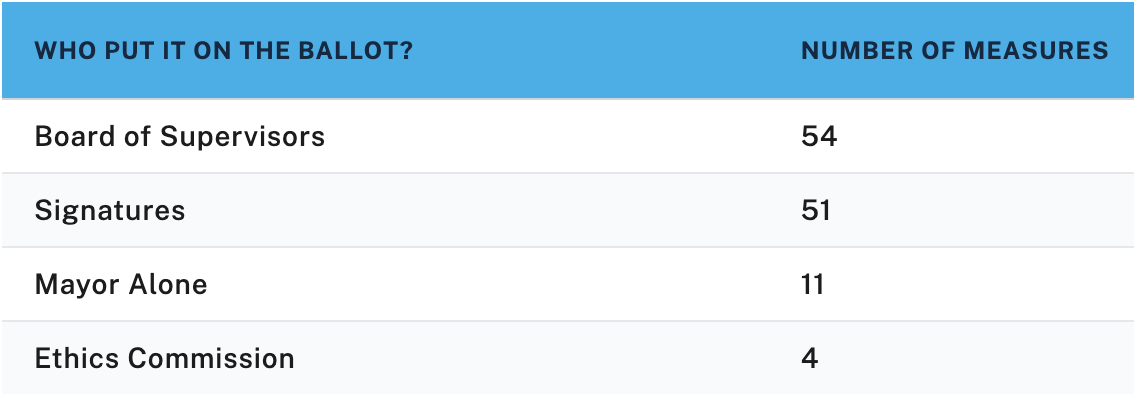
The four from the Ethics Commission followed their legitimate lawmaking process, but the other 116 skipped the normal legislative negotiation process. That’s a lot of laws passed without the usual debate, hearings, or expert input.
A Higher Bar
San Francisco needs to raise the bar for putting measures on the ballot. Not only do we have too many ballot measures, but once they’re passed they’re locked in and unable to be modified by our elected officials. The only way to fix a ballot measure is to pass a new one later, creating a vicious cycle of more and more measures piling up.
So instead of making our most hard-coded laws the easiest to pass with the least oversight, we should flip the script. Let’s make it harder to put measures on the ballot, and easier for our elected officials to govern through City Hall.
Here are some key reforms that we think San Francisco needs:
Raise the threshold for qualifying citizen initiatives from 2% to at least 10% of registered voters, in line with other California cities.
Require a majority of the Board of Supervisors (6 out of 11) plus the Mayor’s approval to place any measure on the ballot, ensuring broader consensus and consent of both branches of government.
Prohibit measures that have no legal requirement to be on the ballot (like regular ordinances) or which have no legal effect (like policy declarations). This would still allow citizen signature initiatives, but would prevent the Board of Supervisors from using the ballot as a political tool for symbolic gestures.
By enacting these reforms, San Francisco can restore some much-needed sanity to its governance. We’ll still have ballot measures—but far fewer, and they will require more scrutiny and debate. Meanwhile, our city government can become more nimble and cohesive. As SPUR succinctly put it, San Francisco needs to “resolve issues through leadership rather than at the ballot”. It’s time to stop the ballot chaos.