

What You Need To Know
Here’s what happened around the city for the week of August 9, 2026:
- Bilal Mahmood Fixed It: New Homes to Rise at Old Car Wash
- November’s Local Ballot Measures
- Mayor Lurie Opposes DSA Housing Tax
- Car Break-Ins Fall 88% From 2017 Peak
- YIMBY Law Sues San Francisco
Bilal Mahmood Fixed It: New Homes to Rise at Old Car Wash
Published August 13, 2026

The Facts
The old car wash at Divisadero and Oak is finally becoming housing, thanks to Supervisor Bilal Mahmood. Greystar, the largest developer of apartments in the US, is scheduled to break ground on October 19 to build an eight-story building with 203 apartments and ground-floor retail, in a scoop reported by J.K. Dineen at the San Francisco Chronicle.
Mahmood’s permit-expiration reform and other bureaucratic fixess finally made the building pencil out, saving about $4 million in construction costs, according to the builder.
It will be the first significant market-rate apartment building to begin construction in San Francisco this year.
The Context
Housing was first proposed here a decade ago, and the developer went through over 1,000 community meetings before giving up. Dean Preston, the former Supervisor, tried hard to kill this building by insisting the city fund fully taxpayer subsidized apartments on the land, even though no funding was available.
In February last year, we reported that this new plan finally won streamlined approval under Assembly Bill 2011, a state law allowing qualifying apartments on commercial land to bypass discretionary review. But the approved plans still couldn’t be built without some more local fixes.
The GrowSF Take
We put up a billboard promising Bilal Mahmood would fix this stalled project. He did.
Mahmood found a specific cost blocking construction, changed the law, and helped turn approved plans into financed homes. His success shows that all we need to do to fix San Francisco is to keep electing sensible people instead of ideologues.
November’s Local Ballot Measures
Prop A merges overlapping city commissions and shuts down ones that no longer meet, saving $365,000 to $450,000 per year.
Prop B authorizes San Francisco to create a city-owned “municipal finance corporation” now and a public bank later, without providing any money for either.
Prop C raises the City’s yearly payment into the Housing Trust Fund from $50.8M to $125M by the 2030s, and indexes future contributions to rising property taxes.
Prop D raises the signature threshold for citizen ballot initiatives from 2% to 8% of registered voters, ends the Mayor’s power to unilaterally put a measure on the ballot, and ends the Board of Supervisors’ power to put a measure on the ballot with a minority vote.
Prop E puts city purchasing rules under the City Administrator and raises the dollar limits at which contracts need Board of Supervisors approval.
Prop F lets the Mayor reorganize departments and hire and fire most department heads directly, with the Board able to block a reorganization.
Prop G reopens the Great Highway to cars on weekdays.
Prop H creates a 15-year parcel tax based on building square footage to fund Muni, raising about $177M per year.
Prop I redirects about $120M per year out of the general fund into a fund restricted to affordable housing.
Prop J ends the transfer tax break for foreclosures on everything except small residential buildings, raising an estimated $100M to $150M per year.
Mayor Lurie Opposes DSA Housing Tax
Published August 13, 2026

The Facts
The DSA’s housing tax attracted its first major opposition this week. Mayor Lurie has come out to oppose the November ballot measure which would redirect taxes on certain from the General Fund into restricted housing programs.
The Controller’s analysis says the measure would shift $120 million per year out of the General Fund, increasing the projected deficit.
Lurie instead backs Proposition C, which would grow the Housing Trust Fund toward $125 million using future property-tax growth.
The Context
The San Francisco Democratic Socialists of America gathered signatures for the measure, which is also backed by former Supervisor Dean Preston.
The GrowSF Take
We have not yet taken a position on any of the local ballot measures, but we did publish our analysis of the ballot language this week. The measure somewhat confusingly worded to sound like a tax reduction, but in short it would redirects about half of a real estate transfer tax away from the general fund and toward subsidized housing.
Proposition C is quite interesting because it indexes the housing subsidy on broader economic growth, effectively aligning incentives to grow the economy while providing a possible path to bonding recurring revenues to build infrastructure faster.
Car Break-Ins Fall 88% From 2017 Peak
Published August 13, 2026

The Facts
Car break-ins are at record lows. We’re down to just 10 per day across the whole city, down almost 90% from the peak in 2017. That’s about 1,800 break-ins through June, compared to 30,000 in 2017 according to SFPD data.
“I feel like it’s a wrap,” [SF rapper] Berner said, citing the cops’ increasing use of drones and cameras. “Everything’s being recorded and documented. If you’re doing crime these days, I don’t know, man. It’s kind of crazy.”
The Context
While car break-ins also fell elsewhere, San Francisco still substantially outperformed that baseline. California Department of Justice data show theft from vehicles dropped 37% statewide from 2022 to 2025, compared with 78% in San Francisco.
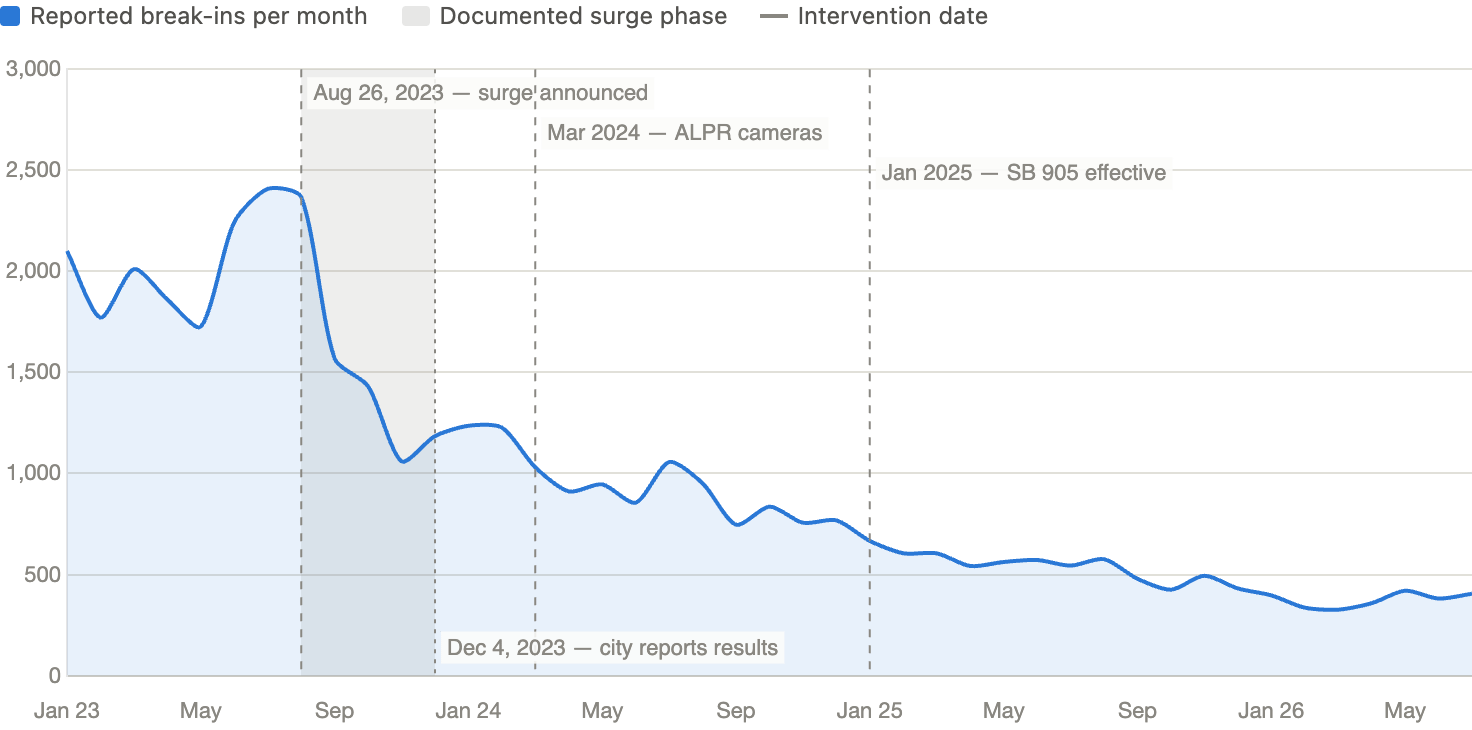
Our analysis of monthly SFPD data found the sharp decline in September 2023 aligned with when Mayor London Breed, Police Chief Bill Scott, and District Attorney Brooke Jenkins launched a targeted enforcement operation against organized crews and stolen-goods networks.
The GrowSF Take
Car break-ins collapsing is a huge win.
The statewide and national decline explains only part of San Francisco’s improvement. The city’s much larger drop, and its abrupt timing in September 2023, strongly suggest that disrupting repeat offenders and the market for stolen goods made a major local difference. Breed, Chief Scott, and DA Jenkins deserve credit for focusing limited police resources where they mattered.
Voters were also right to approve Proposition E. While good policework is an important part of San Francisco’s success, cameras and drones help police identify suspects, build cases, and provide meaningful ongoing deterrence.
YIMBY Law Sues San Francisco
Published August 14, 2026

The Facts
San Francisco may be on the wrong side of the law after it banned new construction in huge swathes of Soma and Bayview last May.
In response, YIMBY Law and two other pro-housing organizations have sued San Francisco to overturn the ban. State law allows industrial land to be exempted from upzoning, but only if that land doesn’t already have housing. The suit alleges that roughly 1,900 parcels were thus illegaly exempted.
You can read their full argument at yimbylaw.org.
The Context
State Senator Scott Wiener’s SB 79 allows denser housing near major transit, but included provisions for Cities to enact alternative plans if they were roughly equivalent. San Francisco took the alternate plan route via Family Zoning.
But the Planning department and the Board of Supervisors added a permanent carve-out for land with warehouses that the state did not require, and, according to the lawsuit, doesn’t allow. GrowSF warned in May that this was foolish.
The GrowSF Take
We think the plaintiffs are right. Preserving genuinely productive industrial land can make sense, but permanently blocking homes on transit-accessible land where housing is already legal does not. The Board should repeal Planning’s carve-out rather than spend years defending it in court only to lose.
Paid for by GrowSF Voter Guide. Not authorized by any candidate, candidate’s committee, or committee controlled by a candidate. Financial disclosures are available at sfethics.org.