

The GrowSF team took a much-needed vacation after last Tuesday, so this is a short one. Come back next week for our regular (too-long) newsletter.
How did San Francisco vote?
We’re extremely thrilled to see Supervisors Stephen Sherrill and Alan Wong win their elections decisively, both with a commanding 69% of the vote. We’re also happy to see Prop A pass and Prop D fail. Here’s a quick rundown of the GrowSF Voter Guide recommendations compared to the voting outcomes — as you can see, voters generally agreed with us! (We should note: we don’t expect these results to change, but only about 65% of votes have been counted so far.)
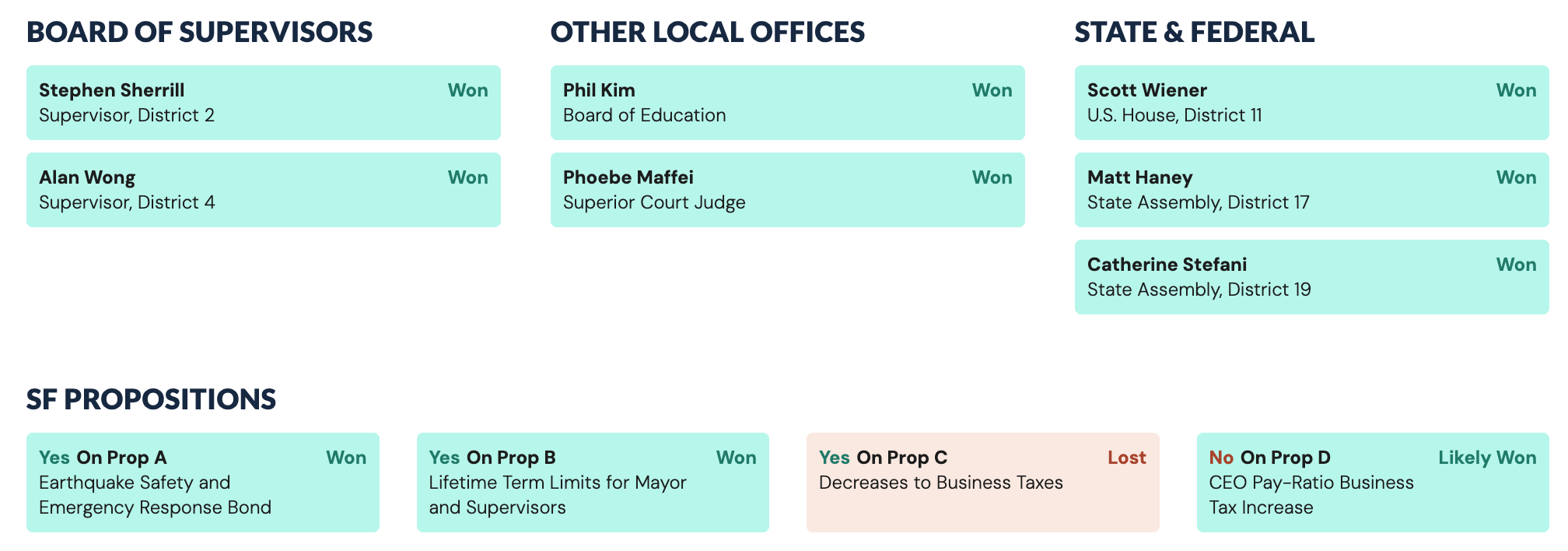
Our state recommendations didn’t fare quite as well, but that’s not unexpected. We explicitly focus on San Francisco and there just aren’t enough SF voters to meaningfully move state races.
Turnout and slow vote counting
Despite the pronouncements of historically low turnout by several media organizations, turnout was higher than June 2022 by about 50,000 voters. As we reported last week, before polls had closed, turnout was consistent with past elections and we predicted between 200,000 and 220,000 total ballots cast. The final number looks like it will beat that estimate, clocking in at about 270,000 ballots.
But let’s talk about what’s really on our minds: why does it take so long to count the results? It shouldn’t be this way. We should know on election night who won, and if we don’t, the Department of Elections should be working 24/7 until they have an answer. Instead, we get just about half of the votes counted on election night, no votes counted the day after, and then a slow trickle of results over the following days. The Department of Elections isn’t even working this weekend, today and tomorrow.
Look, I love the Department of Elections, and I really do think they do an excellent job, but they do fall flat on speed of counting. We shouldn’t be complacent and just say “that’s the way it is.” This needs to be fixed.
Here’s why it’s so slow, and how we can fix it:
The problem: The Department stops counting mail-in ballots the day before the election because they’re preparing the voter rolls for in-person voting. The Department wants to give normal ballots, not provisional ballots, to people who show up at their polling place, so they need to know if someone voted or not.
Since all in-person votes are counted the night of the election, when the department resumes counting mail-in ballots the day after the election, they will flag any mail-in ballots from someone who already voted in person. This means that over 50% ballots are held hostage by the 10% that vote in person.
The fix: Don’t stop counting the mail-in ballots and either verify in real time if someone has already voted (we have computers and telecommunications!) or treat all in-person ballots as provisional.
If the voter had already voted, then when their vote-by-mail ballot is processed, it will be flagged as a duplicate. This will basically never happen because almost nobody votes twice. (I say almost because some people mis-mark or realize they forgot to vote for a race and then show up at a polling place hoping to cast a corrected ballot.)
Also, the department should be counting votes 24/7 until all ballots are counted, and updated results should come out every hour, not every day or every-couple-of-days. Knowing the outcome of our elections—the most sacred aspect of democracy—is too important to delay.